Spectroscopy: the art of making matter speak through light — and how scientists are pushing it further.
From decoding starlight to tracking lithium in volcanic rock, spectroscopy is the universal language between matter and scientists. But as researchers dive deeper into light’s hidden wavelengths, they’re also unlocking new secrets — from our batteries to the heart of medical treatment.
You can also read:
- ATLAS Zeroes In on Rare Higgs Decays — And the Standard Model Is Holding Its Breath
- The First Antimatter Qubit Just Dropped — and It’s Changing Physics Forever
Reading the rainbow — and everything beyond
Imagine shining a beam of light through a prism, watching it burst into a rainbow. That’s the basic idea behind spectroscopy — but real scientists don’t stop at the visible spectrum. They use ultraviolet, infrared, X-rays, and more, to analyze how materials absorb or emit light. Each chemical element has its own “light fingerprint,” a spectral barcode that tells us exactly what it’s made of.
Whether we’re authenticating a Van Gogh, scanning the Martian surface, or tracking air pollutants, chances are someone’s using spectroscopy.
The Atom’s Dirty Secret: Fission Doesn’t Split the Way We Thought
Lithium: the elusive element we rely on every day
Lithium is everywhere — powering our phones, hiding in magma, even dancing in stars — yet spotting it clearly is surprisingly hard. Especially using X-ray spectroscopy, which is often optimized for heavier elements. Lithium’s light signal sits in a tricky, under-explored wavelength range, making it tough to detect with standard tools.
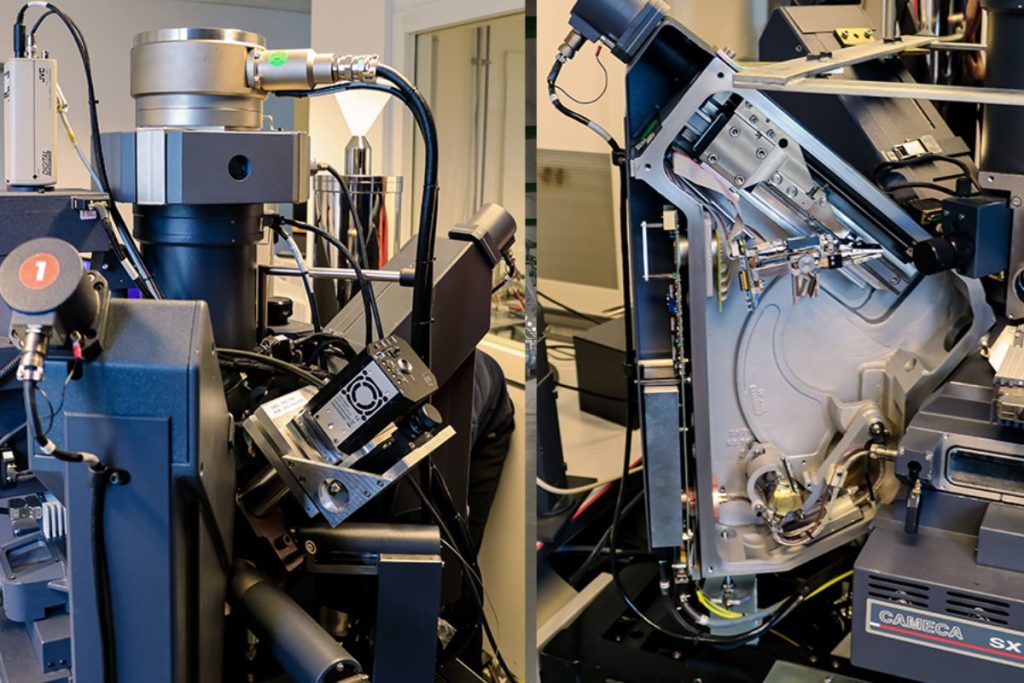
That’s why the SQLX project, led by a team at CNRS and the Camparis analytical facility in Paris, developed a next-generation X-ray spectrometer. Instead of using crystals like conventional devices, they employed a Fresnel optical grating to boost spectral resolution by a factor of 10. The result? Scientists can now see and quantify lithium with remarkable precision — even determine its chemical state and atomic environment.
And it’s not just for lithium. The technology opens the door to detecting other light elements — the building blocks of stars and the early universe.
From mining to volcanoes: why this matters
The new SQLX spectrometer can be mounted on standard lab equipment like scanning electron microscopes or electron microprobes, making it widely accessible. Its applications range from tracking magma flows in volcanology, to mapping lithium in spent batteries, to identifying minerals in exploration geology.
“It’s a leap forward not just for lithium analysis,” explains Philippe Jonnard, the project’s lead scientist, “but for the entire field of light-element detection.”
And since light elements like beryllium, boron, or carbon are not only scientifically fascinating but economically strategic, this matters a lot.
When X-rays meet molecules: how MUSTACHE maps chemical chaos
While SQLX looks at gentle signals from lithium, another project, called MUSTACHE, is doing something much louder: blasting molecules with high-energy X-rays and watching how they explode.
This project focuses on “hard” X-rays — the same kind used in medical radiotherapy. When a molecule absorbs one of these photons, it reacts violently: electrons are ejected, atoms break apart, and fragments fly off in a cascade that scientists still don’t fully understand.
To capture the chaos, researchers at CNRS and their partners built a unique dual-spectroscopy system at the SOLEIL synchrotron. One part records the high-resolution electrons emitted, the other catches the fragments using coincidence mass spectrometry. Together, they reconstruct the molecular response with unmatched clarity.
X-rays and medicine: not just for broken bones
Why should we care about how molecules disintegrate under X-rays?
Because in radiotherapy, we bombard tumors with these same rays. We also inject heavy-element reagents, like iodine and bromine, to boost the effect. Understanding the cascade of chemical reactions that follows can help us design better cancer treatments — more targeted, more effective, and with fewer side effects.
According to Oksana Travnikova, who leads the MUSTACHE project, their work could help refine radiation protocols, especially for treating cancers that resist conventional methods.
A future shaped by light
| Project | Focus | Key innovation | Application |
| SQLX | Detecting light elements like lithium | Uses Fresnel zone plate for high-resolution soft X-ray detection | Batteries, geology, volcanology |
| MUSTACHE | Understanding molecular breakup after hard X-ray absorption | Combines electron spectroscopy + mass spectrometry | Medical imaging, radiotherapy optimization |
They froze a lightning bolt: Scientists snap a petawatt laser in a single shot
A tool for the unseen, from atoms to galaxies
Whether we’re chasing lithium ions in a spent battery or unraveling molecular collapse in a cancer cell, spectroscopy gives us eyes where none exist. As we explore longer, softer wavelengths and harder, deeper X-rays, we’re not just upgrading machines — we’re expanding our ability to ask the right questions.
From the infinitely small to the infinitely far, from geology to medicine to astrophysics, spectroscopy remains one of science’s most powerful lenses. And as these new tools show, we’ve barely scratched the surface of what it can reveal.
Source: https://anr.fr/Projet-ANR-20-CE29-0022
Image:
On the left, a conventional WDS spectrometer of the “Johannsson” type. On the right, the Fresnel zone WDS spectrometer used by the Camparis service as part of the ANR SQLX project. By measuring the X-rays emitted by materials, these spectrometers detect and quantify the lithium they contain. While the former targets a specific wavelength, the latter offers ten times greater spectral resolution, enabling a more precise characterization of lithium. © Clémence Coudret / OSU Ecce Terra / Laboratoire de chimie physique – matière et rayonnement / CNRS.