Europe’s next-generation weather sentinel takes its place inside Ariane 6.
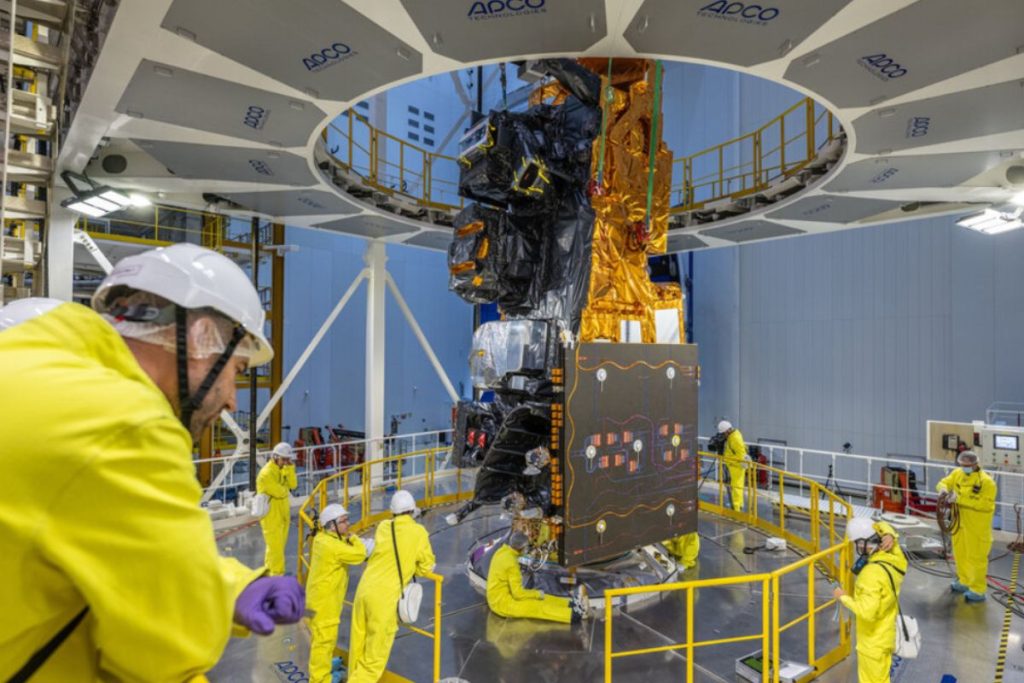
In the humid air of Kourou, French Guiana, engineers closed the two halves of Ariane 6’s protective fairing, hiding from view one of Europe’s most advanced meteorological satellites — MetOp-SG-A1. In just days, it will ride a column of fire into orbit, carrying instruments that will transform how we see Earth’s atmosphere.
You can also read:
From cleanroom to countdown
MetOp-SG-A1 arrived at the European Spaceport in mid-June 2025. Since then, it has been through an intense preparation campaign: exhaustive health checks, the careful loading of nearly 800 kg of volatile propellant, and mechanical integration with its launch adapter.
Now, sealed inside Ariane 6’s fairing, hands-on work is officially over. From here on, the satellite’s environment will be monitored remotely until liftoff at 02:37 CEST on August 13 (21:37 local time, August 12).
For Marc Loiselet, ESA’s MetOp-SG Project Manager who has worked on the mission since 2012, the moment is bittersweet: “None of us will actually see the satellite again — the fairing will only open three minutes and thirty seconds after launch, once MetOp-SG-A1 is on its way to orbit.”
A mission decades in the making
MetOp-SG-A1 is the first of six spacecraft — three pairs of A-type and B-type satellites — to be launched over the next two decades. Together, they will secure Europe’s polar-orbit weather data until at least the mid-2040s, while delivering sharper, more comprehensive measurements than the first MetOp series.
The A-type satellites, like A1, each carry six instruments:
- Next-generation infrared atmospheric sounder
- Microwave sounder for cloud and humidity profiles
- Multispectral imaging radiometer
- Novel multiviewing, multichannel, multipolarisation imager
- Radio occultation sounder (also on B-type satellites)
- Copernicus Sentinel-5 spectrometer for atmospheric composition
Sentinel-5: tracking the air we breathe
Sentinel-5 is no newcomer to Earth observation. Building on the Sentinel-5P (Precursor) mission, the upgraded instrument on MetOp-SG-A1 is a high-performance imaging spectrometer designed to provide daily global maps of:
- Key air pollutants like nitrogen dioxide and ozone
- Essential climate variables
- Stratospheric ozone levels, which shield life from harmful UV radiation
For Didier Martin, ESA’s Sentinel-5 Project Manager, encapsulation is another symbolic step: “Now our focus is entirely on the launch next week.”
Partnership across continents
The MetOp Second Generation programme is the product of long-standing cooperation between ESA and Eumetsat. ESA designs and builds the satellites, while Eumetsat secures the launches, operates the fleet, and distributes data to the global meteorological community.
Sentinel-5 itself is the result of collaboration between ESA, the European Commission, Eumetsat, industry, service providers, and the scientists who will turn raw measurements into actionable information.
Why this launch matters
MetOp-SG-A1 will orbit Earth from pole to pole, gathering high-precision atmospheric data that feed into daily weather forecasts, seasonal climate models, and long-term environmental monitoring. By combining the A-type’s atmospheric instruments with the B-type’s complementary payloads, the system will:
| Capability | Benefit |
| Higher spatial resolution | Finer-scale weather and climate mapping |
| New spectral coverage | Detection of more pollutants and variables |
| Dual-satellite synergy | Cross-checking and complementing measurements |
The last view before space
As Ariane 6 stands on its pad with the fairing closed, the satellite team’s work shifts from assembly to vigilance. In less than a week, MetOp-SG-A1 will be released into orbit — unseen until the fairing opens — to begin its mission of watching over Earth’s atmosphere for the next decade and beyond.
Source: ESA