A new race for the shortest accelerator in history.
In a cavern beneath the Franco-Swiss border, the AWAKE experiment has quietly stepped out of sync with the rest of CERN’s schedule. While the entire accelerator complex will begin its third long shutdown in mid-2026, AWAKE closed its doors more than a year early, on June 1, 2025. Not because of a malfunction, but to get a head start on a transformation designed to push particle acceleration into a smaller, sharper space.
Traditional particle accelerators — from the modest tabletop types in university labs to the $4.75-billion Large Hadron Collider — rely on radio-frequency cavities to give particles their boosts. The trouble is that those metal chambers can only withstand so much electric field before they spark. That physical limit means that higher energies require longer machines: the LHC’s ring stretches for 17 miles.
Plasma offers an escape from that constraint. In this electrically charged soup, stripped atoms can host electric fields hundreds of times stronger than those in metal cavities, enabling huge energy jumps over just a few feet.
You can also read:
- The millisecond AI trick that could keep fusion dreams alive
- The most dangerous metal on the planet is also the only one that doesn’t expand with heat — and now we know why
Surfing on a proton-driven tide
AWAKE takes a particularly unusual approach. Instead of using an electron beam or a laser pulse to stir up the plasma, it fires a high-energy proton beam from the Super Proton Synchrotron. As the protons travel through the plasma, they break into a chain of micro-bunches. Each bunch resonates with the plasma, building up waves strong enough to fling electrons forward at staggering speeds.
Project leader Edda Gschwendtner prefers a nautical analogy: the proton beam is the speedboat, the plasma its wake, and the electrons the surfers who catch the perfect wave. In early tests between 2016 and 2018, those surfers reached multi-GeV speeds — the first time anyone had done it with a proton-driven wakefield.
The second run, from 2021 until this June, confirmed that these proton bunches could sustain high-amplitude waves over a 33-foot plasma section. Now comes the harder task: proving that the process can be scaled up without shredding the quality of the electron beam.
The Atom’s Dirty Secret: Fission Doesn’t Split the Way We Thought
Two plasmas are better than one
The upcoming upgrade will split the job into two distinct plasma cells. The first will act as a self-modulator, breaking the proton beam into those resonant bunches. The second, placed downstream, will take externally injected electrons and drive them to 4–10 GeV in just 33 feet.
That’s not merely an incremental change. It’s a proof-of-principle for a modular architecture: chain enough of these plasma cells together and you could, in theory, shrink a 10-mile accelerator into a space you could walk across in under a minute.
To make room for the new gear, engineers must first dismantle what’s left of the CERN Neutrinos to Gran Sasso (CNGS) experiment, dormant since 2012. CNGS once hurled protons at a graphite target to generate neutrinos for an underground lab in Italy. The catch is that the target and its shielding are now hot with radioactivity, so removal demands specialized containment and a newly built facility to store and treat the debris.
Working ahead of the shutdown clock
CERN’s planners are careful about workforce bottlenecks. By starting early, the AWAKE team can finish the CNGS deconstruction before the main shutdown crunch in July 2026. Once the space is clear, construction of the expanded accelerator hall can proceed without competing for the same crews needed elsewhere.
The schedule is long-range by design: the upgraded AWAKE should be ready to catch the first protons from the SPS in 2029. That gives engineers four years to debug, align, and test every component before attempting full-power acceleration.
The wider stakes
If it works, proton-driven plasma wakefield acceleration could ripple far beyond CERN. Future high-energy physics projects are currently mired in budget estimates that spiral into the tens of billions of dollars and require campus-sized sites. AWAKE’s method could reduce both costs and footprint, making cutting-edge accelerators feasible for more countries — or even for applications outside pure physics, from medical imaging to radiation therapy.
Of course, the technique must prove it can deliver beams as stable and precise as those from conventional machines. It’s the difference between a speedboat racing across a calm lake and one bouncing over unpredictable swells: fast is only useful if you know exactly where you’ll land.
Europe just locked away its most advanced weather eye — next stop: space
The test to come
When the SPS fires its first protons into the upgraded AWAKE, the goal won’t just be higher electron energy. It will be controlled acceleration in a compact footprint, the kind of performance that could rewrite how we think about particle physics infrastructure.
The irony is that the real revolution may not come from smashing particles together at record energies, but from the quiet perfection of the waves that carry them there.
Source: CERN
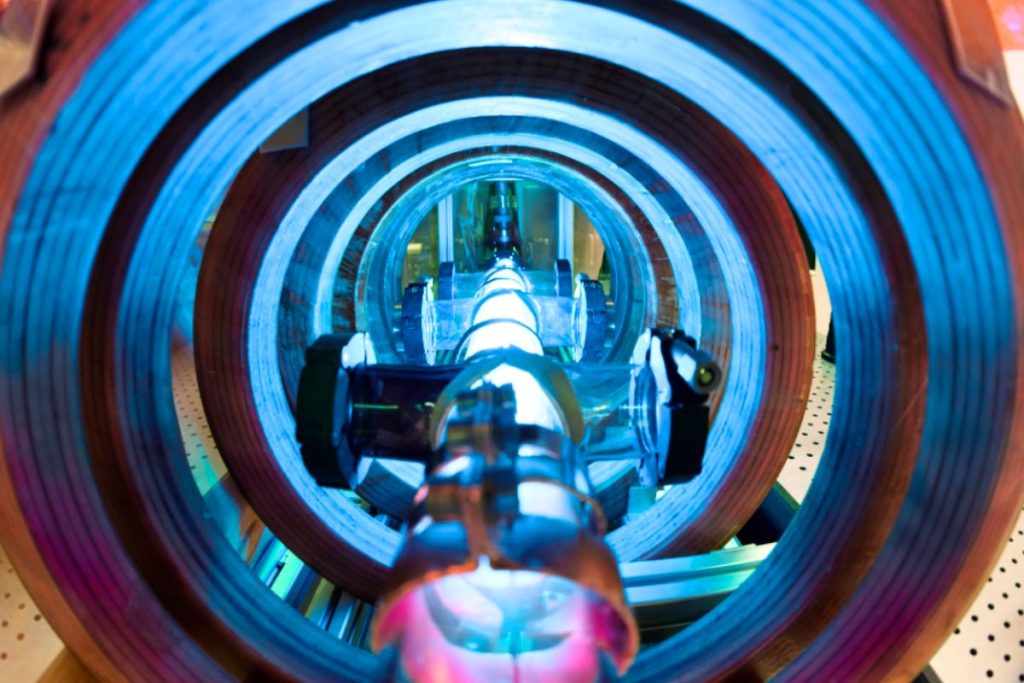
Image: The AWAKE helicon plasma cell prototype as a candidate for scalable plasma sources. (Image: CERN)