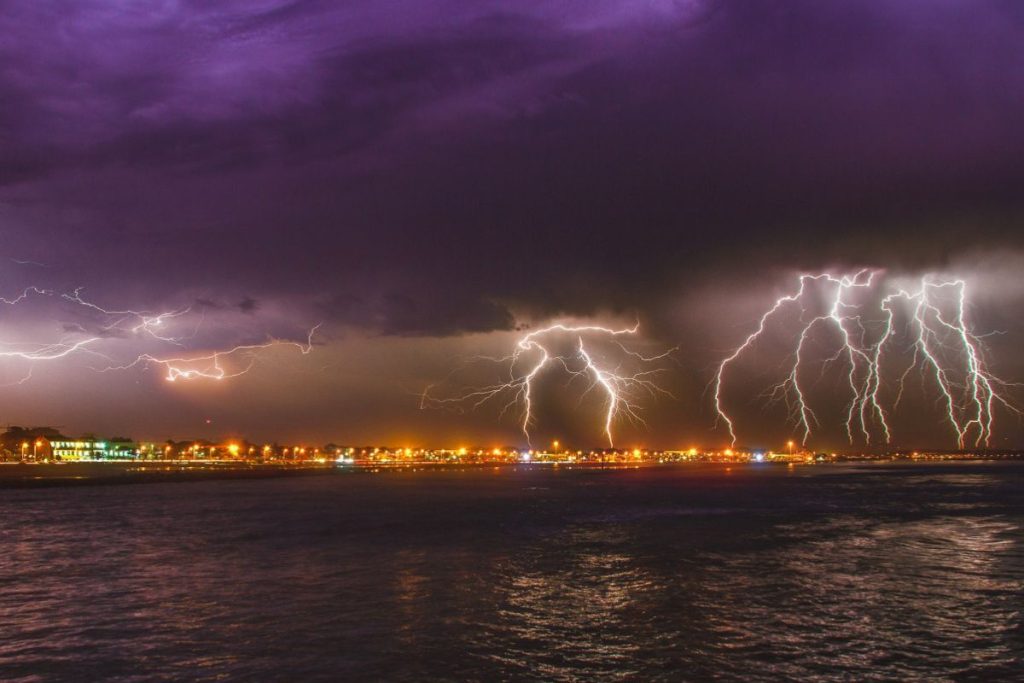
Lightning kills 320 million trees a year — and could quietly supercharge the climate crisis.
We’ve long feared lightning for its fires, its flash, and its fury. But now, researchers say its most devastating legacy might not be human deaths or electrical damage — it’s trees. Hundreds of millions of them. A silent, global deforestation event that no chainsaw, no bulldozer, and no human even touches.
You can also read:
- Older Than the Dinosaurs, Longer Than France: These Buried Volcanoes Are Rewriting Earth’s Story
- The $280 million icebreaker that navigates antarctic darkness to illuminate global science
Nature’s deadliest bolt: one tree every tenth of a second
Lightning might strike in an instant, but its toll on forests is constant. A new study, led by scientists at the Technical University of Munich (TUM) and published in Global Change Biology, estimates that 320 million trees die each year due to lightning strikes. That’s nearly one tree every 0.1 second.
To put that in perspective: lightning kills more than ten thousand times more trees than humans annually — just under 25,000 people are struck each year. And that number only includes direct lightning-induced tree deaths, not those later consumed in fire.
Carbon released, climate wounded
Dead trees don’t just vanish — they release their stored carbon. According to the researchers, this adds up to an estimated 1.09 billion tonnes of CO₂ every year.
That’s nearly 3% of annual global biomass loss, gone not to logging, drought, or disease — but to electrical discharges from above. And while trees eventually grow back, the carbon they release lingers in the atmosphere for decades, adding a silent but massive pulse to the climate system.
It’s a natural process, yes. But as lightning frequency shifts and forests struggle to adapt to climate change, this “natural” role may spiral into something far more destabilizing.
Three reasons may explain the “unexpected” presence of this black iceberg in the Arctic
A rainforest struck — then the world recalculated
To get these numbers, the TUM team didn’t just look up and hope to catch lightning in action. They combined cutting-edge detection systems with ground-level data. At the heart of the study: Barro Colorado Island in Panama, home to one of the world’s most ancient tropical forests.
There, scientists used high-speed lightning cameras, paired with years of field data, to verify their math models. When the trees struck in the model matched the ones dying in reality, they knew they were onto something.
They then scaled up — testing their models in temperate and tropical forests across the globe. They integrated data from space-based lightning sensors, Earth observation satellites, and boots-on-the-ground measurements. The result: a global estimate never before attempted.
Lightning doesn’t strike evenly
Dig deeper, and the results reveal a troubling pattern.
- While lightning accounts for just 0.69% of overall tree deaths, it causes 6.3% of the deaths among large, mature trees.
- In tropical forests, tree mortality from lightning is already higher than in temperate zones.
- But projections suggest lightning frequency will increase most in temperate and boreal regions — making their forests the next hotspots.
That’s bad news, because larger trees store more carbon. When they die, not only is more CO₂ released, but entire forest structures and canopies collapse — affecting biodiversity, water cycles, and local climate regulation.
A stormier future is already brewing
It gets worse. Separate studies cited by Science Alert suggest that by 2100:
- Lightning strikes could increase by 25% to 50%
- Deaths among large trees could rise by 9% to 18%
And yet — and this is perhaps the most alarming finding of all — none of this is currently included in the models scientists use to predict how forests will respond to climate change.
So while we measure carbon emissions from tailpipes and power plants with increasing precision, the sky itself may be rewriting the carbon script in ways we’re barely tracking.
500 million years in hiding: Antarctica’s buried mountain chain shocks scientists again
What this means — and what comes next
| Key Finding | Impact |
| 320 million trees/year killed by lightning | Major contributor to global forest structure changes |
| 1.09 billion tonnes of CO₂/year released | Roughly equivalent to Japan’s annual emissions |
| 6.3% of large tree deaths caused by lightning | Disproportionate effect on carbon-rich trees |
| Rising strike frequency in temperate regions | Boreal and mid-latitude forests increasingly at risk |
| Underrepresented in climate models | Calls for urgent integration into forest-carbon forecasting tools |
Lightning: from spectacle to sleeper threat
For centuries, lightning has inspired awe, fear, and superstition. We’ve captured it in poetry, in mythology, in photos of awe-striking storms.
But now, it’s demanding a new kind of attention — as a driver of forest mortality and climate feedback loops. As one of the study’s authors, Andreas Krause, puts it: “If we don’t account for this mortality in our climate models, we’re missing a key part of the puzzle.”
Lightning isn’t just striking twice — it’s striking millions of times, all over the world. And with every bolt, a tree falls, a bit more carbon escapes, and our planet tilts just a little further into the unknown.
Source:
Simulating Lightning-Induced Tree Mortality in the Dynamic Global Vegetation Model LPJ-GUESS
Andreas Krause, Konstantin Gregor, Benjamin F. Meyer, Anja Rammig
First published: 24 June 2025 https://doi.org/10.1111/gcb.70312
Funding: This work was supported by Deutsche Forschungsgemeinschaft, 536753546.