
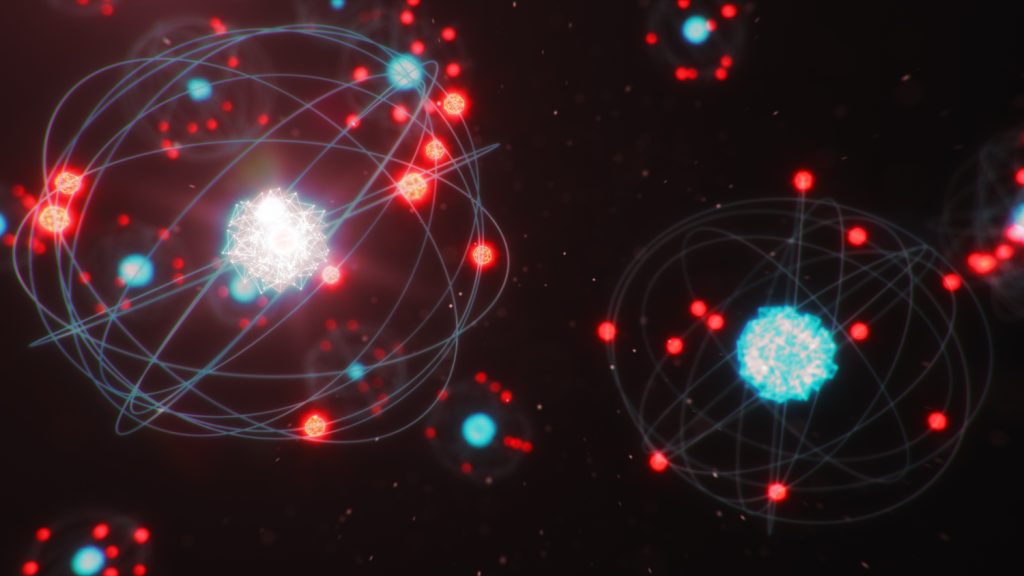
Nuclear fission just broke its own rules — and physicists are rewriting the map.
For decades, we thought we understood how atomic nuclei split: clean cuts, symmetric fragments, predictable behavior. But now, a French-led team has cracked open a nuclear mystery that challenges one of fission’s core assumptions. Turns out, when atoms break, they don’t always do it neatly — and they’re not just misbehaving at the heavy end of the periodic table.
You can also read:
- Better late than never: a forgotten 1938 experiment just reshaped nuclear fusion research
- They froze a lightning bolt: Scientists snap a petawatt laser in a single shot
The watermelon paradox in nuclear fission
Picture this: you’ve got an overripe watermelon. You try slicing it straight down the middle. You expect two equal halves, right? But instead, you get one massive chunk and a much smaller piece — every single time.
That’s basically what happens in asymmetric nuclear fission. A nucleus doesn’t split evenly. It prefers to break into a big fragment and a smaller one, like it’s making a deliberate choice — not a mistake. And while this odd behavior was thought to only affect ultra-heavy atoms like uranium or plutonium, new evidence just shattered that idea.
Nuclear: a handshake in Washington that could power the future
A new island in the fission map
Researchers from the CEA (French Alternative Energies and Atomic Energy Commission), supported by an international team, have identified a whole new “island” of asymmetric fission — not in uranium, but in lighter nuclei like mercury (Hg).
It’s as if someone was redrawing the world map of nuclear physics and stumbled across an entire missing continent. This “fission island” lies in a region no one expected, far from the heavy actinides traditionally associated with asymmetry.
Published in Nature, the findings suggest that shell effects in lighter fragments — a kind of internal nuclear structure — can drive this unexpected behavior. The physics behind it is subtle, and frankly, we’re only beginning to grasp what it means.
Why stars — and reactors — care
So why does this matter? Because fission isn’t just a lab curiosity. It’s a cosmic engine.
When neutron stars collide or massive stars explode as supernovae, the Universe churns out heavy elements via nuclear fission. Knowing how nuclei split — and how often asymmetry occurs — is key to understanding how the elements of the periodic table are created.
Here on Earth, the implications are just as real. Nuclear reactors rely on precise models of fission to predict:
- which particles and isotopes will be produced
- how much energy will be released
- what radioactive waste will remain
If asymmetric fission is more widespread than previously believed, those models need urgent updates — and that affects fuel design, waste management, safety assessments, and the next generation of reactor engineering.
The nucleus doesn’t always play fair
There’s something almost poetic about the idea that even at the subatomic level, matter isn’t perfectly balanced. The world inside an atomic nucleus favors imperfection, leaning into asymmetry, irregularity, and unpredictability.
This isn’t just theoretical hand-waving. The CEA team used cutting-edge detection techniques at GSI/FAIR in Germany, tracking the fission of light isotopes under controlled conditions. What they saw wasn’t noise — it was a new pattern, one that upends decades of assumptions.
Rethinking a 1938 discovery
Back in 1938, Otto Hahn and Fritz Strassmann first described induced nuclear fission — a historic moment that set off the nuclear age. Since then, physicists have refined the theory, but asymmetry was largely boxed into the realm of heavy nuclei.
That box just got blown wide open.
It’s a powerful reminder: even in the most studied reactions in physics, there are still surprises hidden in the details. And when those details surface, they don’t just rewrite textbooks — they shift how we design technologies, explore the cosmos, and understand our atomic origins.
Key takeaways from the CEA discovery
| Aspect | Old Assumption | New Finding |
| Asymmetric fission | Only in very heavy nuclei (U, Pu) | Also occurs in lighter nuclei like mercury |
| Role of shell effects | Important mainly in heavy fission | Crucial in light-fragment asymmetry |
| Astrophysical relevance | Minor outside actinide region | May affect nucleosynthesis in stars |
| Reactor modeling impact | Limited to known fission isotopes | Broader review of yield predictions needed |
| Timeline of discovery | Fission theory stable for decades | Revised in Nature, July 2025 |
Source:
Morfouace, P., Taieb, J., Chatillon, A. et al. An asymmetric fission island driven by shell effects in light fragments. Nature 641, 339–344 (2025). https://doi.org/10.1038/s41586-025-08882-7
Image: J. Hosan / GSI-FAIR / CEA