Buried giants: China uncovers a 700-kilometer chain of fossil volcanoes older than life itself.
Longer than the road from Paris to Marseille. Buried under the Earth for nearly a billion years. Hidden in silence, forgotten by time — until now. Deep beneath southern China, geologists have discovered an ancient volcanic scar that could rewrite what we thought we knew about plate tectonics, climate, and the Earth’s early history.
You can also read:
- 500 million years in hiding: Antarctica’s buried mountain chain shocks scientists again
- Three reasons may explain the “unexpected” presence of this black iceberg in the Arctic
A forgotten fire beneath our feet
Stretching 700 kilometers long and 50 kilometers wide, this newly uncovered chain of “ghost volcanoes” once spewed fire and gas in a world before animals had even evolved. Their last eruption? About 800 million years ago, back when the Earth was still a single supercontinent known as Rodinia.
At the time, what we now call southern China was still attached to this colossal landmass. But as Rodinia fractured, the Yangtze plate drifted, colliding with a nearby oceanic plate. That collision triggered subduction — one plate sliding beneath another, melting into magma, and forming a line of volcanoes. Not just one or two. Hundreds, arranged in a perfect arc deep within the continent.
France is gearing up for a scientific offensive in the ice—and it’s not just about penguins
A magnetic fingerprint from the deep past
But how do you detect a volcano that’s been buried and dormant since before the dinosaurs?
Not with shovels. With airborne magnetometers — instruments that scan the Earth like an MRI. Flying over Sichuan, scientists noticed a strangely iron-rich strip of crust, perfectly straight, hundreds of kilometers long. Beneath the surface, something massive was hidden.
Drilling confirmed it: volcanic arc rocks packed with ancient minerals, dating from 770 to 820 million years ago. These volcanoes had been buried in silence — until now.
A geological behavior that breaks the rules
Here’s where it gets weird. These volcanoes were found deep inland, far from any ancient shoreline. But typically, subduction-triggered volcanoes form along coasts, where plates meet — think of the Andes or Japan.
So how did this happen? The researchers suggest a rare scenario: flat-slab subduction. Instead of diving steeply beneath the continent, the oceanic plate slid in horizontally like a sheet under a mattress. This would have dragged the volcanic activity hundreds of kilometers inland, creating the strange inland arc we see today.
It’s unusual. It’s poorly understood. And it’s a golden opportunity to challenge and refine tectonic theory.
Long-dead volcanoes that may have shaped our climate
You might think these ancient volcanoes have no relevance today. But their echoes still shape the Earth’s story — especially when it comes to climate.
When they were active, these giants released vast amounts of CO₂, enough to throw the global carbon cycle into chaos. According to some scientists, their emissions may have helped trigger the “Snowball Earth” glaciation, a time when ice covered almost the entire planet.
Yes, even extinct volcanoes can cast a shadow across geologic time.
The Earth remembers
What this discovery really shows is that the planet has memory. Not the kind we write in books, but etched into layers of basalt and iron, folded deep beneath the crust.
These volcanoes haven’t erupted in hundreds of millions of years. Not even the dinosaurs saw them. And yet, they speak to us now — through magnetic anomalies, through rocks drilled from 6,500 meters below, through the steady detective work of scientists chasing whispers through time.
They are a buried library, sealed under tectonic layers, and we’ve only just cracked open the first chapter.
The $280 million icebreaker that navigates antarctic darkness to illuminate global science
Key facts at a glance:
| Feature | Detail |
| Age of volcanic arc | 770–820 million years |
| Length of arc | 700 kilometers |
| Depth of rock core drilling | Up to 6,500 meters |
| Plate involved | Yangtze block (South China) |
| Detection method | Airborne magnetometry + core sampling |
| Climatic impact (hypothesis) | Possible contributor to Snowball Earth |
Source:
“700-km-Long Fossil Tonian Magmatic Arc Belt Hidden Within the Yangtze Block’s Interior, South China”
Authors: Zhidong Gu, Junyong Li, Xiaolei Wang, Ya Xu, Xiufen Zhai
Published June 30, 2025, DOI: 10.1029/2024JB030825
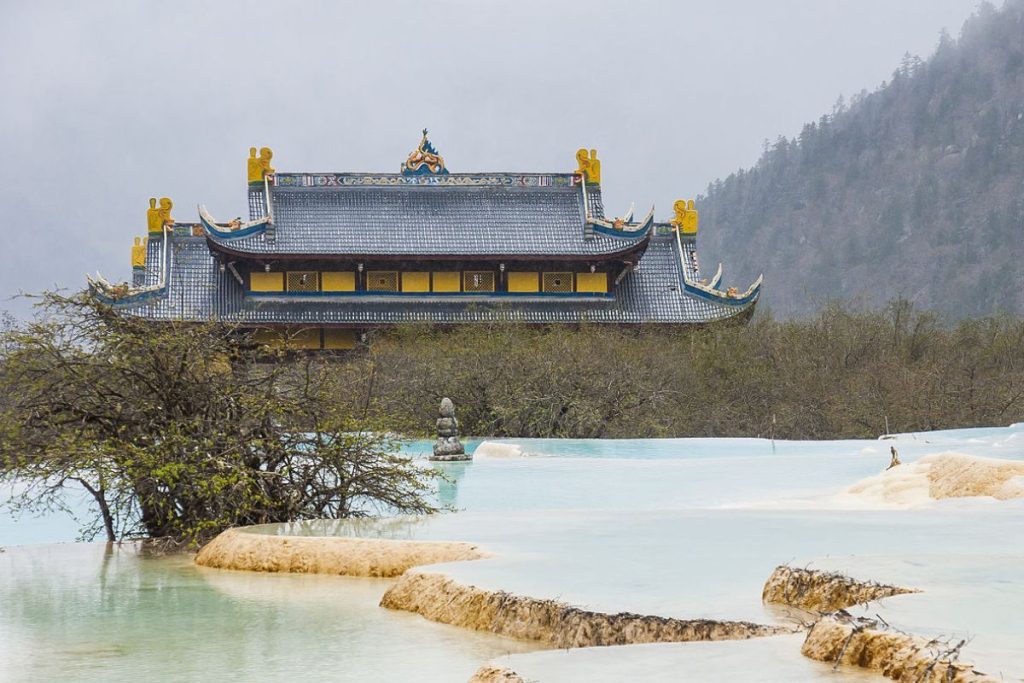
Image: View of the Temple of the Yellow Dragon (Chinese Buddhism) in Huanglong.