Reshaping polar research while the poles melt.
The news broke quietly on July 11, 2025. But in the world of science diplomacy and environmental urgency, it landed like a tectonic crack under the Antarctic crust.
France is reorganizing its entire polar research strategy. The French Polar Institute (IPEV) will officially join Ifremer—France’s leading oceanography institute—by the end of 2026. Meanwhile, the CNRS will take over the coordination of all polar science at the national level.
Not just an institutional shuffle. A shift in scale.
It’s the French equivalent of a scientific “Plan Marshall,” built to face a world where ice sheets are disappearing, biodiversity is upended, and polar oceans are becoming geopolitically and climatically central.
You can also read:
- Three reasons may explain the “unexpected” presence of this black iceberg in the Arctic
- 500 million years in hiding: Antarctica’s buried mountain chain shocks scientists again
A merger of ice and salt
At the heart of this new alliance is the decision to label IPEV a “Very Large Research Infrastructure” (IR*), placing it among France’s top-tier scientific tools. It will be absorbed into Ifremer—not erased, but restructured—into a specialized directorate, much like the integration of France’s oceanographic fleet in 2018.
David Renault, a polar biologist and professor at the University of Rennes, has been named captain of this fusion. He’ll steer IPEV’s transition into Ifremer while keeping the scientific mission intact.
Meanwhile, the CNRS will define national priorities, unify research agendas, and bring together ministries, universities, and international partners. It’s not about switching logos. It’s about building a more coherent, agile, and interdisciplinary research machine.
Six polar stations—and dozens of lonely outposts
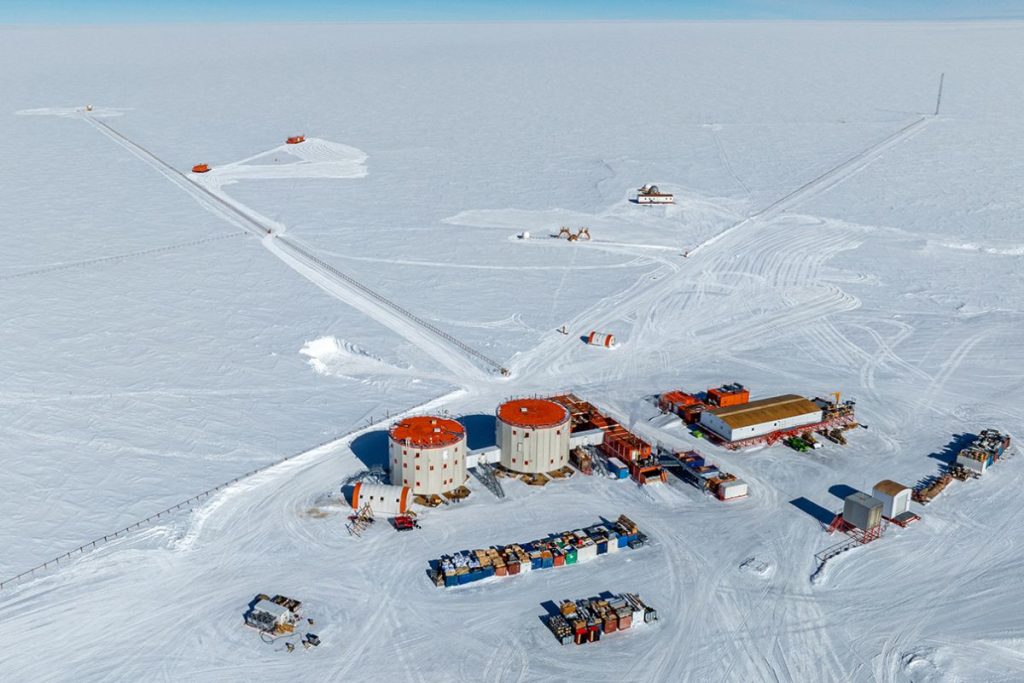
IPEV isn’t just a central office in Brest. It coordinates over 80 projects a year, across six stations that reach from the high Arctic to the remote sub-Antarctic islands.
- Dumont d’Urville and Concordia in Antarctica
- AWIPEV in the Arctic
- Dozens of research shelters on Kerguelen, Crozet, and Amsterdam Islands
These are not five-star accommodations. This is science done in parkas and frozen breath, far from the comforts of lecture halls.
And the research is vital: climate science, seismology, astrophysics, ecology, even human biology under extreme conditions. These datasets don’t exist anywhere else—and they feed directly into climate models, sea level predictions, and global risk assessments.
A national roadmap with international ambition
In June 2025, at the United Nations Ocean Conference in Nice, the CNRS unveiled France’s first national polar research strategy. It was clear, sharp, and ambitious.
For CNRS president Antoine Petit, polar science is now a diplomatic lever. France isn’t just doing research—it’s trying to shape the global conversation on climate, Arctic navigation, and Antarctic governance.
The science ministry backs the vision. So does ambassador Olivier Poivre d’Arvor, who’s made the poles a diplomatic priority. In short, France wants to trade ice cores for influence.
No more silos: science goes “One Environment”
Until now, polar research in France often ran in separate tracks: climate here, biology there, oceanography somewhere else.
The new alliance aims to smash those silos. To link ice sheet melt with ocean currents. To relate penguin populations to chemical changes in sea ice. To ask big questions that connect systems across time and scale.
It’s called the “One Environment” approach: one planet, one set of interconnected systems, one scientific voice. No more stovepipes—just snowballing collaborations.
Can France really be a polar power?
By station count? No.
France has just two bases in Antarctica—only one (Dumont d’Urville) occupied year-round. Compare that to Argentina’s 13, Australia’s 12, or even the UK’s 6.
But scientific weight isn’t just about flag-planting. As Renault puts it: “Antarctica isn’t a territory to conquer—it’s a laboratory to understand.”
France wants to win by doing better science, coordinating better teams, and speaking louder in international forums.
And that’s where this restructuring aims to deliver: less redundancy, more vision, more impact.
<br>
Antarctic presence by country
| Country | Total Bases | Year-Round Bases | Seasonal Bases | Main Purpose |
|---|---|---|---|---|
| Argentina | 13 | 6 | 7 | Scientific + logistical |
| Australia | 12 | 6 | 6 | Scientific |
| France | 2 | 1 | 1 | Scientific |
| United States | 7 | 5 | 2 | Scientific + logistical |
| Chile | 8 | 6 | 2 | Scientific |
| United Kingdom | 6 | 4 | 2 | Scientific |
| Russia | 7 | 5 | 2 | Scientific |
| Norway | 3 | 2 | 1 | Scientific |
| New Zealand | 3 | 2 | 1 | Scientific |
| Japan | 2 | 2 | 0 | Scientific |
| South Africa | 2 | 1 | 1 | Scientific |
| Belgium | 1 | 1 | 0 | Scientific |
The poles are melting and France is moving
There are no votes in Antarctica. No borders. No pipelines. Just ice, data, and time.
But time is running out.
This new French strategy is less about expansion than consolidation. Not planting flags, but laying down knowledge, with precision and long-term vision.
And maybe that’s how power works in the age of climate urgency: not by how much land you hold, but by how much truth you can extract from the ice—before it’s gone.
Source: CNRS
Image: Gunther Lawers / Institut polaire français