A floating research hive on the edge of the world.
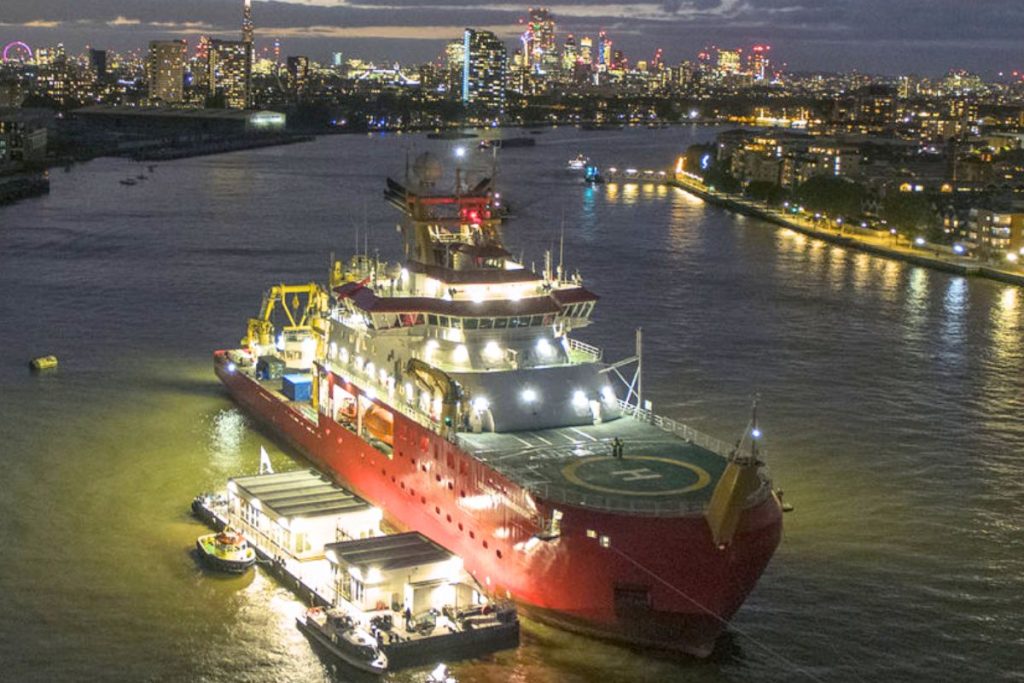
You’re drifting through blackness, cold gnawing at every joint, when a massive red vessel appears—like something out of a sci-fi hallucination. This isn’t a scene from a Ridley Scott film. It’s midwinter in Antarctica, and the RRS Sir David Attenborough is carving its path through frozen silence at the bottom of the world.
Outside, the sun has vanished for months. Winds roar at 100 miles per hour. Yet inside this British-built leviathan, it’s anything but dormant. The labs glow. Seawater samples swirl through centrifuges. Seals bump into underwater sensors. A soft hum pulses underfoot: engines, data streams, life.
Winter isn’t supposed to be the season for exploration here. That’s what makes this ship matter.
You can also read:
- 500 million years in hiding: Antarctica’s buried mountain chain shocks scientists again
- Three reasons may explain the “unexpected” presence of this black iceberg in the Arctic
Why winter means science
For decades, Antarctic science had a rhythm: show up in summer, when 24-hour daylight made things more forgiving. Winter? Forget it. Too dark. Too cold. Too dangerous. But that’s like trying to understand a novel by reading only the first half.
The RRS Sir David Attenborough flips that script. This 423-foot ship has been designed to push through sea ice up to 3 feet thick at a steady 3 knots. Its mission this past winter: observe the hidden half of Earth’s southern engine.
In February, as the continent entered its long sleep, the ship slipped between icebergs and headed for uncharted waters. Its sonar scanned seafloor ridges under retreating glaciers. Underwater drones documented submarine melting, the quiet but relentless erosion happening below the ice. And from beneath the frozen ocean, a revelation emerged: winter glaciers don’t just suffer—they feed. Nutrient-rich water was seeping from the ice and nourishing entire ecosystems in the dark.
Yes, the coldest places still bloom.
What’s in a floating lab?
Everything. Every square inch of the Sir David Attenborough is an invitation to discovery. Onboard instruments measure salinity, chlorophyll, oxygen levels, and dissolved carbon with a granularity that satellites can’t match. There are sediment traps that look like sci-fi umbrellas. Robotic probes dive into the abyss. Autonomous surface drones surf the sea, beaming back snapshots of reality at 62° South.
Here’s what powers it all:
| Feature | Specification |
| Length | 423 feet |
| Beam (width) | 79 feet |
| Gross Tonnage | 15,000 tons |
| Scientific cargo volume | ~31,800 cubic feet |
| Endurance | 60 days |
| Range | 21,800 miles at 13 knots |
| Icebreaking capacity | 3 feet of ice at 3 knots |
| Dynamic positioning | Bow and stern thrusters |
| Robotic systems | Launch & recovery of aerial/undersea drones |
| Crew | ~30 |
| Research team capacity | Up to 60 scientists/support staff |
It’s not just a ship. It’s a mobile continent of thought.
The price of discovery
The construction of this research icebreaker cost approximately $280 million. That figure may sting, but consider this: no satellite can peer through a mile of Antarctic ice. No aircraft can linger over a frozen ocean in February. And no other ship combines such endurance, icebreaking power, and scientific instrumentation.
Every data point gathered in this glacial void helps refine climate models, sea level predictions, and ocean circulation forecasts. These models govern everything from how we farm to how we build coastal cities.
When Antarctic waters shift, Indian monsoons can falter. When polar jets reorganize, South American droughts can spike. The price tag isn’t just for science—it’s for future-proofing.
Antarctica’s invisible clockwork
The RRS Sir David Attenborough doesn’t just trace maps. It unravels hidden dynamics. Beneath sea ice, abyssal mixing redistributes carbon and heat. Beneath glaciers, pulses of freshwater slide into circulation belts that span the globe. These aren’t trivial details. They’re the gears of climate.
And winter is their test lab. Without light, phytoplankton retreat, predators shift their hunting grounds, and physical changes become traceable with stunning clarity. In that darkness, a different kind of signal emerges.
That’s what this ship is chasing: the rhythms of a world that still holds secrets.
Sources:
- British Antarctic Survey – RRS Sir David Attenborough
- UK Natural Environment Research Council – Technical Specs
- ESA CryoSat observations
Credit photo: RRS Sir David Attenborough in London during the PreCOP26 Ice Worlds Festival