A logistical fever dream wrapped in steel.
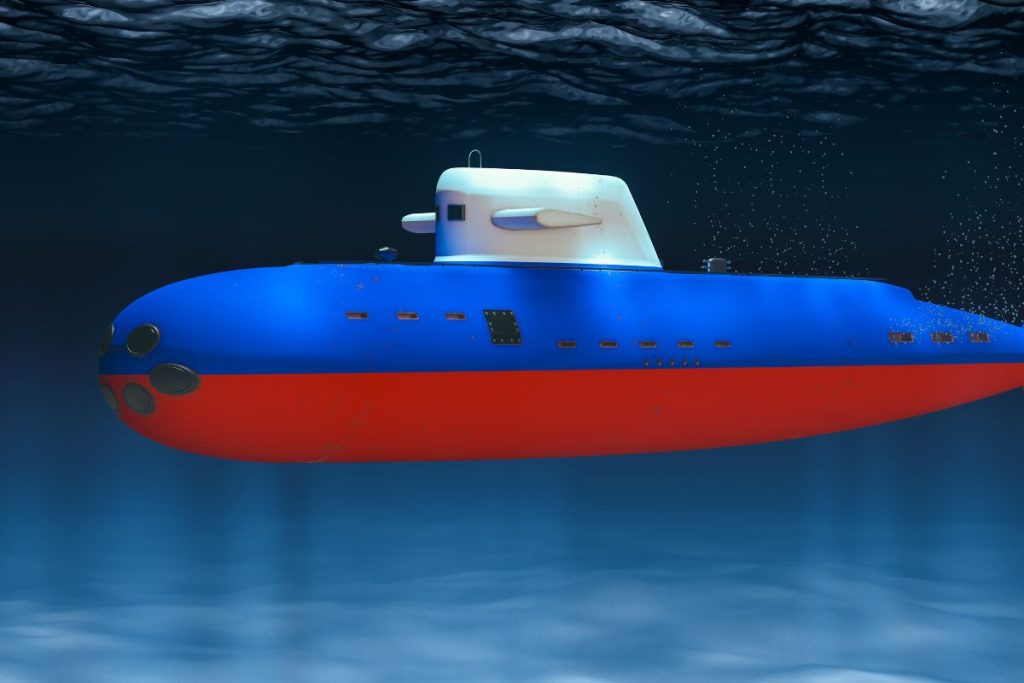
A nuclear submarine, three reactors humming below the surface, hauling liquefied natural gas through the Arctic ice. Sounds like science fiction—or at least a Bond villain’s retirement plan. But this is a real project, confirmed by Russian authorities and already under development. The vision: massive civilian submersibles carrying natural gas across the Northern Sea Route (NSR), far from prying eyes, economic sanctions, and the crushing force of Arctic ice.
The Ministry of Transport is on board. So is the Kurchatov Institute. And yes, Vladimir Putin has publicly backed the idea. The plan is to reduce cargo time, avoid chokepoints like the Suez Canal, and make Russia’s Arctic ambitions not just plausible, but profitable.
Giant Russian submarines to ahul LNG under the Ice ?
The propulsion setup is not just bold—it’s dense. Each sub would pack three Rhythm-200 nuclear reactors, each producing 30 megawatts of thermal power. These reactors drive three electric motors, also rated at 30 megawatts each, making every vessel a kind of floating hydroelectric plant in disguise.
The submarine would cruise beneath the ice at a steady 17 knots (about 20 mph), unaffected by storms or shifting sea ice. It’s not speed that matters here. It’s reliability. The sub doesn’t need an icebreaker escort. It doesn’t care about weather delays. It keeps going—twelve months a year.
That’s a potential cut from 20 days down to 12 on the Northern Sea Route. In logistical terms, that’s game-changing.
After 15 years, China finally launches mass production of its Boeing-sized amphibious giant
Avoiding ice—and everything else
Why a submarine instead of a tanker? Because the Arctic is a terrible place to be a ship.
Ice is unpredictable. Weather turns violent fast. Surface ships face a thousand risks: collisions, drifting floes, extreme cold, not to mention surveillance and economic restrictions. But a sub? It’s below it all—literally. That means fewer hazards, fewer delays, and no need for vulnerable above-water infrastructure.
And the flexibility is geopolitical, too. With Western sanctions making offshore gas investments riskier, this underwater alternative sidesteps the need for international cooperation. No pipeline? No problem. Just send a sub.
Pipe dream—or pipeline killer?
It’s a clever workaround. No seabed pipeline to sabotage. No ports required along contested coastlines. Just autonomous vessels diving from Point A to Point B.
In theory, a small fleet of these cargo subs could match the flow rate of an underwater pipeline. This makes them attractive not only as a logistical tool, but as a strategic weapon in economic resilience.
But critics have a long list of doubts.
Designing and building a nuclear-powered cargo sub isn’t like slapping wheels on a gas truck. It requires specialized components, many of which are imported. Supply chains are complex, and the costs are astronomical. Even Russia’s major shipyards would need serious upgrades to handle construction.
On top of that, Arctic ports are decades behind in terms of infrastructure. Refitting them to handle LNG subs means dredging, quay reinforcement, specialized recharging facilities, and nuclear safety protocols. That’s an investment measured not in millions, but in billions of dollars.
A presidential nod—and high stakes
Still, the Kremlin isn’t backing down. In early 2025, Putin said this “exotic” idea now looks “realistic and commercially viable.” His endorsement wasn’t abstract—Gazprom and Novatek, the country’s LNG giants, are both evaluating the plan seriously.
And the timing matters. With European markets turning away from Russian gas, and southern routes exposed to conflict and piracy, the Arctic becomes a lifeline.
Russia is counting on the NSR to carry over 34 million tons of LNG per year by 2030, and nuclear cargo subs may be the only way to do it without massive international cooperation.
The specs, laid bare
Here’s what one of these aquatic behemoths might look like on paper:
| Component | Specification |
| Type | Civilian nuclear-powered cargo submarine |
| Reactors | 3 × Rhythm-200 (30 MW each) |
| Electric motors | 3 × 30 MW |
| Cruising speed | 17 knots (20 mph) |
| NSR transit duration | 12 days (down from 20) |
| Projected NSR capacity (2030) | 34+ million tons per year |
Frozen ambition
If the project moves forward, it would represent a new kind of logistics platform, one that blurs the line between military technology and commercial infrastructure.
Is it risky? Without question. Expensive? Absolutely. But the logic is pure geopolitics: when your economy relies on exports and your borders are increasingly isolated, you build under the ice.
Whether these submarines ever slip silently beneath the Arctic ice sheet or remain a paper fantasy, one thing is clear: Russia is thinking deep—in both senses of the word.