Teaching AI to see shadows where the plasma won’t burn.
Inside a fusion reactor, heat is everywhere—except in the places it isn’t. These cold spots, called magnetic shadows, are shielded from plasma by other components of the machine. Finding them is vital, because in a reactor that burns hotter than the sun’s core, even a small surface exposed to plasma can be toast in seconds.
Now, a new artificial intelligence tool, HEAT-ML, is making that search dramatically faster. Developed through a partnership between Commonwealth Fusion Systems (CFS), Princeton Plasma Physics Lab (PPPL), and Oak Ridge National Lab, the system cuts a 30-minute calculation down to mere milliseconds.
You can also read:
- Better late than never: a forgotten 1938 experiment just reshaped nuclear fusion research
- France breaks fusion record with Thales’ monster gyrotron—and it’s just getting started
A shortcut through a complex forest of magnets
In a fusion device like the SPARC tokamak, magnetic fields twist and curve to hold a writhing plasma in place. The job of engineers is to figure out what parts of the reactor’s inner wall will be scorched and what parts will hide in the magnetic shadows.
The original software, HEAT, tracked magnetic field lines from component surfaces, checking whether they collided with any other piece of hardware before hitting the plasma. That meant navigating through a 3D jungle of reactor geometry—tile by tile. For a full section of SPARC’s divertor (15 tiles), one simulation could take half an hour. Multiply that across hundreds of iterations, and you’ve got a serious design bottleneck.
HEAT-ML fixes that. Using a deep neural network, it learned to predict magnetic shadows after being trained on 1,000 simulations from the original HEAT code. Now it can estimate where plasma will or won’t hit with a speed fit for real-time use.
Shadows in a machine built to shine
The target of this new model is a specific area of SPARC—the divertor, where the plasma exhaust slams into the wall. That’s where the heat is most intense, and where protective design really matters. Even a small miscalculation here could lead to a shutdown costing millions of dollars.
Magnetic shadows offer a refuge. If engineers can place delicate components in those regions, they avoid the full brunt of the plasma. But the magnetic field inside a tokamak isn’t intuitive. It curls, loops, and bends like a high-energy pretzel. That’s why computational tools—especially fast ones—are so essential.
From proof-of-concept to design companion
For now, HEAT-ML is laser-focused on SPARC’s exhaust system. It’s not yet generalized. But researchers want to expand it to any shape or surface inside any tokamak. That means faster iterations during design, smarter configuration during operations, and less risk when the machines are finally switched on.
And because it runs so quickly, HEAT-ML could eventually be used not just for planning but for live control—adjusting plasma on the fly to avoid hot spots, reroute power, or extend component lifetimes.
The Atom’s Dirty Secret: Fission Doesn’t Split the Way We Thought
AI that learns from physics, not replaces it
This isn’t black-box AI guessing at results. It’s physics-informed machine learning, trained on real simulations, rooted in known geometry and magnetic behavior. The system doesn’t invent shortcuts—it just recognizes patterns faster than we can calculate them.
As reactors get bigger, denser, and more intricate, tools like HEAT-ML may become standard—an AI companion running alongside every new fusion shot, every component redesign, every heat flux model.
And if it helps keep the plasma from melting a million-dollar tile, well, that’s a good day at the office.
Source:
Shadow masks predictions in SPARC tokamak plasma-facing components using HEAT code and machine learning methods
Author links open overlay panelD. Corona a, M. Scotto d’Abusco a, M. Churchill a, S. Munaretto a, A. Kleiner a, A. Wingen c, T. Looby b
https://doi.org/10.1016/j.fusengdes.2025.115010
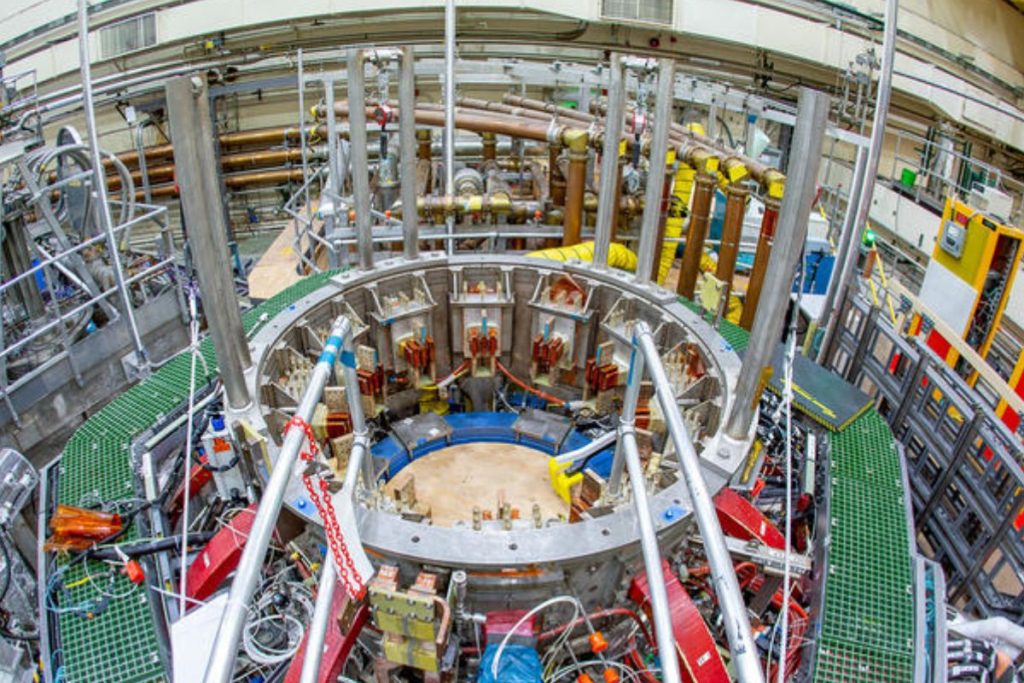
Image: NSTX-U is a spherical tokamak, a fusion device shaped more like a cored apple than the doughnut-like shape of conventional tokamaks (credits: Princeton Plasma Physics Lab).