
A metal that cools when heated? Inside delta-plutonium’s puzzling shrinkage.
Plutonium doesn’t behave like other metals. Heat it up, and instead of expanding like a balloon in the sun, it shrinks—as if recoiling from the warmth. This bizarre property shows up in its delta phase, a particular crystalline form that has baffled scientists for decades.
Now, researchers at a U.S. national lab have found the missing piece: it all comes down to magnetic turbulence at the atomic level.
You can also read:
- France’s helium crisis is a warning—the CNRS Is fighting back with cold logic and hot science
- Turning plastic into power: the solar trick hidden in your trash
Plutonium: six personalities in one element
Plutonium has six different solid phases under normal pressure, each with its own density, structure, and behavior. From alpha (α) to epsilon (ε), it shifts forms depending on temperature. One moment it’s brittle and compact, the next it becomes pliable and puffy—before collapsing again.
The most industrially interesting of these is delta-plutonium, which appears around 590°F. It’s ductile and easier to work with, unlike the dense and stubborn alpha form. But delta-plutonium contracts as it gets hotter, losing up to 3% of its volume—a problem for engineers who prefer their metals to stay put.
The big question: why?
Nuclear: a handshake in Washington that could power the future
Heat, meet magnetism
The answer lies in magnetic entropy. As the temperature rises, plutonium’s internal magnetic behavior becomes chaotic. Electrons that normally align in predictable ways start to jitter and flip, creating a tangle of fluctuating magnetic moments.
Scientists modeled this behavior using a new free-energy framework. They calculated how temperature-dependent magnetism alters the atomic bonds. The result? As the magnetic disorder increases, the material’s energy balance shifts, and its lattice contracts.
Instead of swelling under heat like most metals, delta-plutonium folds inward.
From equations to evidence
The new model finally aligns theory with reality. Earlier explanations didn’t account for how magnetism subtly influences volume, especially in metals with unstable electron shells like plutonium. When the math starts to reflect what lab experiments show, that’s when physicists start paying attention.
This isn’t just abstract theory. Real-world measurements of volume, thermal expansion, and magnetostrictive behavior all fit the predictions. The puzzle, for once, has a shape that matches the box.
Why it matters beyond plutonium
Delta-plutonium may be the headline, but the implications ripple outward. Materials like iron, nickel alloys, and certain steels used in reactors and ships also undergo magnetic transitions that affect how they expand or contract.
Knowing how magnetism affects shape and volume allows scientists to predict material behavior in extreme environments—from the inside of a nuclear core to the crust of the Earth.
It’s not just about keeping metals from warping. It’s about understanding the rules they secretly obey.
Imperfection is the next frontier
One caveat: the model still assumes ideal conditions. Perfect crystals, flawless structures, no stray atoms. But in the real world, plutonium is messy. It’s full of defects, doped with gallium or aluminum, and shaped by past abuse. That messiness is what determines how it performs over time—whether it cracks, swells, or quietly degrades in storage.
The next step is to feed this imperfection into the equations. Not just to predict the shape of plutonium today, but how it might deform, split, or fail decades down the line. That matters for long-term nuclear storage, weapon reliability, and the safe operation of anything containing this most unpredictable of metals.
Sometimes, the smallest shrink is the biggest clue.
Source:
First principles free energy model with dynamic magnetism for δ-plutonium
Per Söderlind, A Landa, L X Benedict, N Goldman, R Q Hood, K E Kweon, E E Moore, A Perron, B Sadigh, C J Wu
Published 21 July 2025
Reports on Progress in Physics, Volume 88, Number 7
Citation Per Söderlind et al 2025 Rep. Prog. Phys. 88 078001
DOI 10.1088/1361-6633/adedb1
Image:
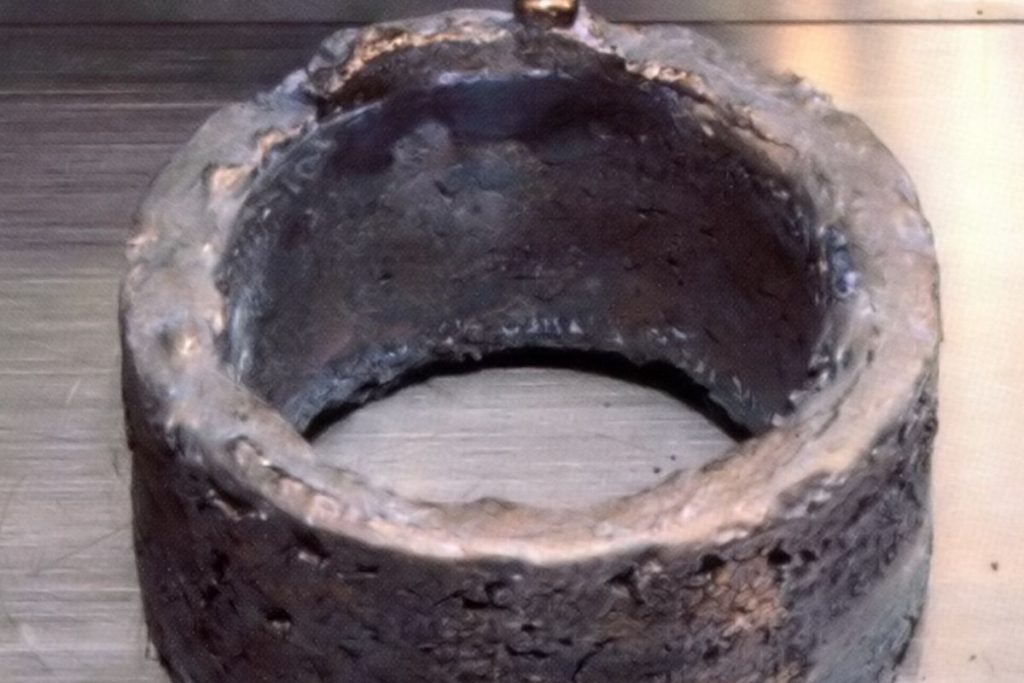
5.3 kg piece of electro-refined plutonium with over 99.96% purity, about 11 cm in diameter, intended for the manufacture of a nuclear warhead. The annular shape is designed to prevent the risk of a criticality accident.