Radiation is everywhere, but dose is everything.
Radiation is not an exotic threat lurking in distant power plants. It’s in bananas. It’s in your basement. It’s in the sunbeams on your skin. That’s because radioactivity is a natural feature of matter, stemming from unstable atoms—called radionuclides—that decay into other atoms by emitting energy.
What matters is intensity and duration. A low, consistent dose? Generally harmless. But ramp up the exposure, or stretch it over time, and you’re in trouble. High doses can cause skin burns, cell death, DNA breakage, and eventually cancer. At very high levels, radiation doesn’t just damage cells, it annihilates them.
The dose makes the poison. That’s as true for uranium as it is for caffeine.
You can also read:
- Finland approves a nuclear reactor that doesn’t make electricity—and that might be the point
- The Atom’s Dirty Secret: Fission Doesn’t Split the Way We Thought
Not all radioactive waste glows the same way
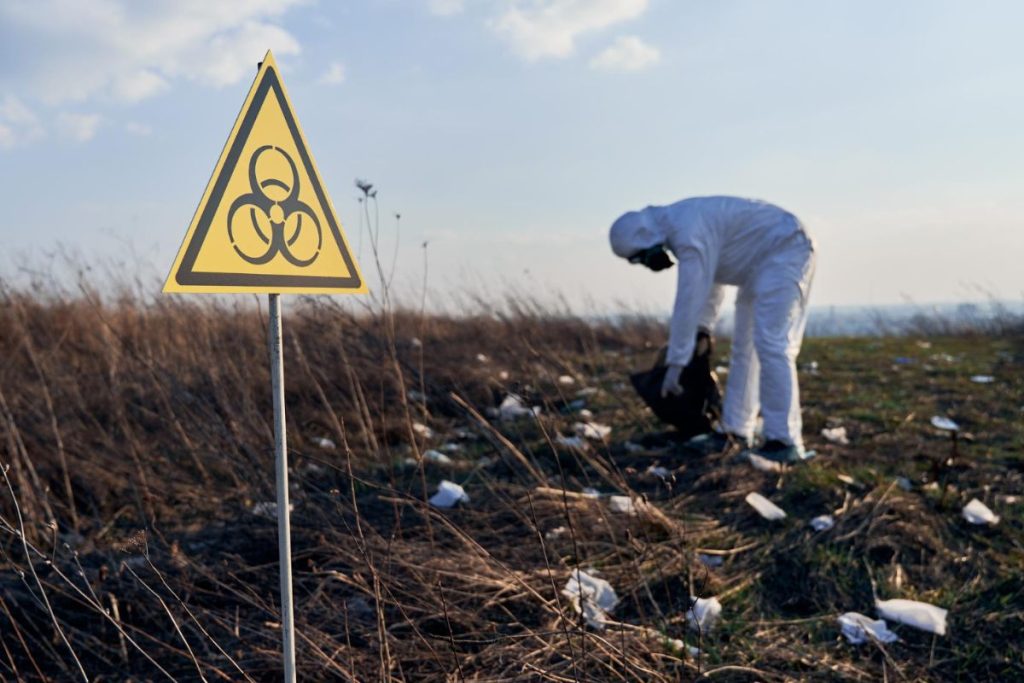
The word “waste” is misleading—it sounds inert. But radioactive waste is anything but. It’s the byproduct of medical treatments, power generation, research labs, and yes, weapons manufacturing. And it comes in wildly different forms.
Some decay in hours. Others—like those from nuclear fuel reprocessing—remain hazardous for hundreds of thousands of years. That’s not poetic exaggeration. It’s literal half-lives.
In France, short-lived medical waste is simply left to decay on its own until it becomes safe—often just a matter of weeks. Mid-level waste is stored in surface facilities for up to 300 years. The real problem lies with high-level waste, the kind dense with radionuclides, which can outlive civilizations.
These are handled by ANDRA, France’s nuclear waste agency, which coordinates containment and long-term management. But even the best concrete and stainless steel won’t last 10,000 years. Hence the push for geological storage—hiding it deep underground and hoping rock does what steel can’t.
Nuclear: a handshake in Washington that could power the future
Burial is the preferred strategy. For now.
The French plan, like many others, centers around deep geological repositories—vaults dug into stable bedrock, hundreds of feet below the surface. The goal? Seal away the waste, wait out the decay, and trust the geology to remain undisturbed.
Sounds clean. Except for one thing: Time.
We’re talking about isolation over epochs. Not decades. Not centuries. Epochs. That means figuring out how to pass on the knowledge of what we buried—and where—to future societies who may not speak our language, or use our symbols, or even know what radiation is. The challenge isn’t just technical. It’s cultural, even philosophical.
Meanwhile, researchers like Patrick Chardon are retracing older mistakes. From 1950 to 1990, barrels of radioactive waste were sunk in the deep ocean, a practice that now feels like hiding mercury in a child’s sandbox. Chardon’s team is currently collecting seabed samples to study how decades-old waste is interacting with marine ecosystems. Spoiler: probably not great.
Radioactive waste is not just a nuclear problem
While nuclear power gets most of the attention, radioactive waste comes from far more places. Hospitals generate it every day, using isotopes in diagnostics and cancer treatments. Industrial facilities use it in imaging and material testing. Even universities contribute.
In all these cases, short-lived isotopes are common—but their cumulative volume is anything but trivial.
Managing these streams safely requires tracking, containment, and a logistics system that doesn’t blink. And it gets more complicated when waste streams mix—like medical devices containing sealed sources, which can be forgotten and later treated as scrap metal. (Yes, that’s happened.)
The measurement game
This is where people like Chardon come in. His job at the French National Center for Scientific Research (CNRS) is to quantify radiation precisely, whether it’s coming from the soil, a medical scanner, or a barrel rusting on the seafloor. That means calculating dose rates, absorption, and biological impacts.
It also means being the voice of reason when the word “radioactive” triggers panic. Context matters. A millirem on your flight to Denver isn’t the same as a sievert near a melted fuel rod. Most people don’t get that distinction, and the media doesn’t help.
The future depends on how we treat the past
What happens next depends on whether we treat radioactive waste as a long-term engineering challenge, or a legacy problem to bury and forget. The temptation to move on is strong. The half-lives are stronger.
For now, engineers, physicists, ecologists, and historians are all working together, not just to build safer storage, but to design communication that can endure across languages, institutions, even species.
Because once you create long-lived radioactive waste, you’re committed to the long game. And whether future humans live in domed cities or cave dwellings, they’ll still need to know what lies beneath their feet.
Source: https://www.cnrs.fr/fr/actualite/trois-choses-savoir-sur-la-radioactivite-et-les-dechets-radioactifs