
LHC breathes new life into particle physics with first-ever proton–oxygen collisions.
What happens when protons crash into oxygen ions at nearly the speed of light? On June 29, 2025, the Large Hadron Collider (LHC) launched a never-before-seen experiment: smashing proton beams into beams of oxygen. This unprecedented run is set to rewrite parts of high-energy physics—one ion at a time.
You can also read:
- ATLAS Zeroes In on Rare Higgs Decays — And the Standard Model Is Holding Its Breath
- The First Antimatter Qubit Just Dropped — and It’s Changing Physics Forever
A fresh gust of data in the LHC tunnel
For the first time in its history, CERN’s LHC is colliding protons with oxygen ions, marking the start of a rare ten-day campaign that runs until July 9. The schedule is tight and ambitious: two days of proton–oxygen collisions, followed by oxygen–oxygen, and wrapping up with a full day of neon–neon collisions.
This is not just a scientific novelty. These collisions are goldmines for physicists exploring everything from cosmic ray dynamics to the mysteries of the quark–gluon plasma. That’s the exotic state of matter believed to have filled the universe just microseconds after the Big Bang.
Older Than the Dinosaurs, Longer Than France: These Buried Volcanoes Are Rewriting Earth’s Story
From the Linac to the collision point: an intricate ballet
Bringing oxygen and neon to the collision point isn’t a plug-and-play task. It took months of tuning across CERN’s entire accelerator chain, starting with Linac 3, then moving through LEIR, PS, SPS, and finally, the LHC itself.
Each machine had to be retuned to handle these ions. Unlike protons, oxygen ions have a different charge-to-mass ratio, meaning they’re pushed and pulled differently by the LHC’s electromagnetic fields. “Without careful correction, the beams would miss each other completely,” explains Roderik Bruce, LHC ion specialist.
To make them collide exactly at the four main detectors—ALICE, ATLAS, CMS, and LHCb—engineers fine-tuned the beam energy, rotation frequency, and pulse timing to nanometric precision.
One experiment, many players
While ALICE and the other main detectors get much of the spotlight, several other experiments are hitching a ride on this unique campaign.
LHCf, which studies cosmic ray physics, installed a special detector 140 meters downstream from ATLAS. Its goal: analyze small-angle particles produced by the proton–oxygen collisions. For the oxygen–oxygen and neon–neon phases, the LHCf team will replace it with a high-resolution calorimeter.
Meanwhile, collimation tests are underway. Ions generate so-called beam halos—stray particles that drift from the beam’s core. To manage this, the LHC is testing crystal collimators, a cutting-edge upgrade to guide these rogue ions safely away from the magnets and sensors.
A taste of cosmic truth
Why all this fuss over oxygen and neon? These elements are abundant in cosmic rays, so recreating their collisions in a controlled environment lets physicists simulate natural astrophysical events at an unprecedented scale.
But these collisions aren’t just about emulating space. They also probe the strong nuclear force and could offer fresh insight into how matter behaved moments after the Big Bang. With light ions like oxygen, physicists can explore a sweet spot between the clean simplicity of proton collisions and the ultra-complex chaos of heavy ion interactions.
A glitch in the beam
It’s not all smooth sailing. One unexpected challenge: beam contamination.
As oxygen ions collide, they can generate secondary particles with the same charge-to-mass ratio. These “impostors” sneak into the beam and can mess with measurements. “With protons, this isn’t a problem,” says Roderik Bruce. “But with oxygen, we may need to purge the beam mid-run and inject fresh ions.”
This contamination—called transmutation—is still poorly understood. Scientists will need to analyze data in real time to decide how often beams must be replaced.
Nuclear: a handshake in Washington that could power the future
The next few days could change everything
What happens when oxygen meets oxygen? When neon collides with itself at near-light speed? CERN is about to find out.
And with each collision, physicists are not just collecting terabytes of data—they’re inching closer to answers about the fundamental forces that shaped the universe. From dark matter to the structure of the atomic nucleus, this run could reveal layers of the cosmos we’ve never seen before.
Stay tuned. The LHC just took a deep breath—and it might exhale something extraordinary.
Quick facts:
| Parameter | Detail |
| Start date | June 29, 2025 |
| Ions used | Oxygen (O), Neon (Ne) |
| First-time event | Proton–Oxygen, Oxygen–Oxygen, Neon–Neon |
| Purpose | Study strong force, cosmic rays, QGP |
| Challenge | Beam contamination from secondary particles |
| Lead experiments | ALICE, ATLAS, CMS, LHCb, LHCf |
| Beamline innovation | Crystal collimator tests |
Source: CERN
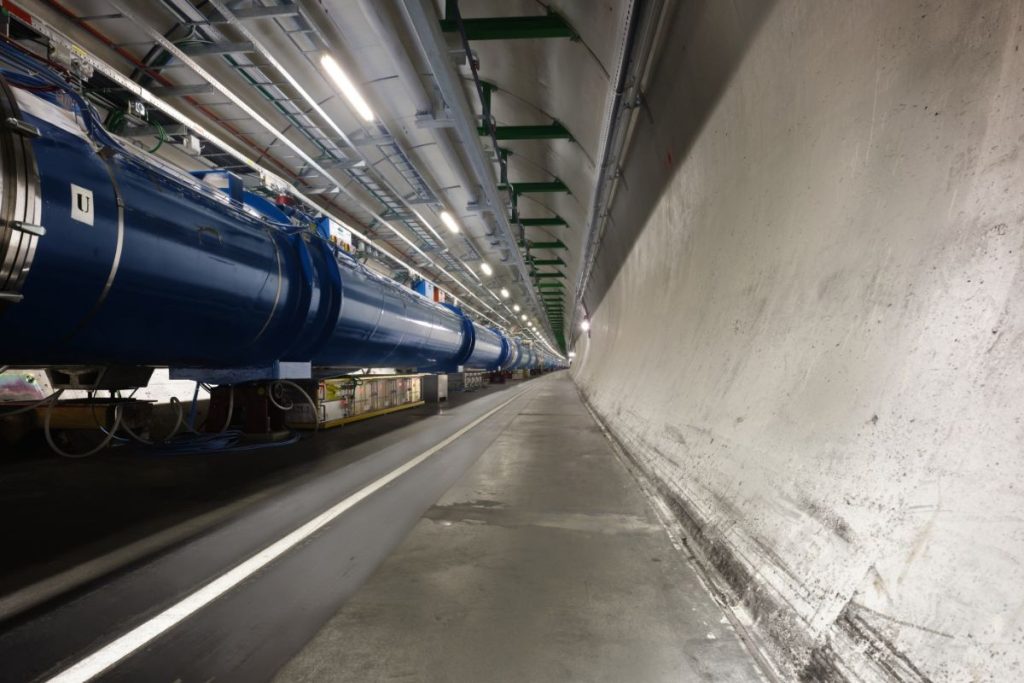
Image: In the LHC tunnel. (credit: CERN)