
BASE at CERN just built an antimatter Qubit. Precision physics starts now.
It sounds like science fiction: physicists trapping a single antiproton and making it oscillate between quantum states for nearly a minute. But this isn’t a futuristic dream. It happened. And it could rewrite the rules of how we test the universe.
You can also read:
- They fused carbon like stars do — And caught it on camera
- Finland just synthesized the heaviest proton-emitting isotope ever seen
One tiny antiproton, one giant leap for quantum physics
At the CERN Antimatter Factory, researchers from the BASE collaboration have just pulled off a world first: they’ve created the very first qubit of antimatter. More precisely, they managed to flip the spin of a trapped antiproton back and forth — coherently — for 50 full seconds.
That may sound technical, but it’s as groundbreaking as it gets. Why? Because this tiny bit of antimatter could soon help us probe some of the deepest mysteries in physics, including why the universe is made of matter at all.
France quietly built the most powerful laser on Earth—And it’s hidden in a bunker
What exactly did they do?
Let’s break it down.
A qubit, or quantum bit, is the building block of a quantum computer. It’s a system that can be in two states at once — like a coin that’s both heads and tails, until you look at it.
In this experiment, the qubit wasn’t just any particle. It was an antiproton — the antimatter twin of the proton, same mass, opposite charge. Using ultra-precise Penning traps and ultra-clean electromagnetic fields, the BASE team was able to make this single antiproton “swing” back and forth between its two spin states, like a quantum-scale swing pushed with perfect timing.
Imagine trying to push a child on a swing so gently, so precisely, that it keeps moving perfectly for almost a full minute — all while being suspended in a vacuum and isolated from the entire environment. Now imagine the swing is a single particle from antimatter.
That’s what they did.
Why this matters more than you think
The experiment might sound like a technical feat — and it is — but it’s also a major step toward testing a core symmetry of the universe: CPT symmetry. This fundamental rule says that matter and antimatter should behave exactly the same if you flip their charge, mirror them, and reverse time.
But the universe doesn’t seem to care. Matter is everywhere. Antimatter? Practically gone. Something doesn’t add up — and this new antimatter qubit might be our most precise way yet to detect if the symmetry breaks down.
Before this, scientists could only observe “incoherent” transitions — noisy, imperfect flips disturbed by magnetic fluctuations. Now, with this coherent method, they can watch the spin state evolve cleanly, in real time, with vastly better control.
Beyond the Standard Model?
In previous experiments, BASE had already shown that the magnetic moment of the proton and the antiproton matched to within a few parts per billion. If that equality ever breaks — even slightly — it would shatter the Standard Model of physics.
With this new qubit-based method, the team expects to improve measurement precision by a factor of 10 to 100. That’s not just better numbers. It’s a genuine possibility to uncover new physics.
And if you’re wondering whether this means quantum computing with antimatter is around the corner — not yet. “This qubit won’t be used to store your emails,” jokes Stefan Ulmer, spokesperson for BASE. “But it could tell us something we’ve never known about why the universe looks the way it does.”
The BASE-STEP twist: taking antimatter on the road
The next big leap? A transportable antimatter setup. BASE is developing BASE-STEP, a way to move antiprotons from CERN to quieter, magnetically calmer labs. Why? Because even tiny fluctuations can cause quantum decoherence, destroying the delicate spin-flip dance.
Barbara Latacz, lead author of the study, explains: “In these improved environments, we might be able to keep the spin qubit coherent for up to ten times longer. That’s not just technical icing on the cake — that could be the key to unlocking next-generation antimatter research.”
They froze a lightning bolt: Scientists snap a petawatt laser in a single shot
From quantum curiosity to cosmic clues
This isn’t just a niche physics experiment. It touches the big questions. Why is there something rather than nothing? Why did matter win over antimatter in the early universe? What happens to the fundamental laws of nature at their limits?
With this first antimatter qubit, we now have a new tool, exquisitely sensitive and beautifully strange, to go hunting for answers.
And who knows — maybe the next clue about the universe’s missing antimatter won’t come from a giant telescope or a particle collider, but from a lone antiproton… quietly spinning in the dark.
Source: CERN
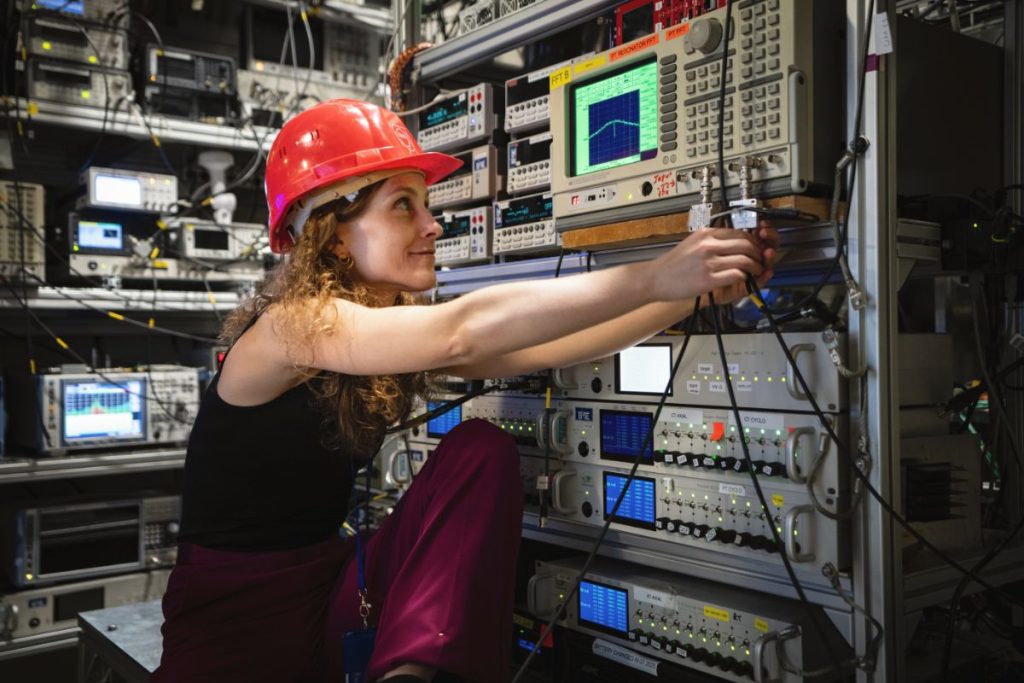
Image: Physicist Barbara Latacz working on the BASE experiment (image: CERN)