
When the gas runs dry, research holds its breath.
It’s light. It’s inert. It doesn’t react, doesn’t bond, barely even exists in our atmosphere. And yet, helium is the invisible thread that holds together some of the most advanced science in the world.
Used to cool superconducting magnets in MRI machines, cryogenic spectrometers, quantum devices, and space propulsion systems, helium is not optional in research—it’s essential. But now, it’s also expensive, geopolitical, and increasingly unreliable.
In France, the CNRS (National Center for Scientific Research) is leading the charge to stop science from suffocating.
You can also read:
- Glass bottles release more microplastics than plastic or aluminum: a French study shakes up assumption
- Turning plastic into power: the solar trick hidden in your trash
A ballooning problem
In 2018, a liter of liquid helium cost around $5. By 2023, that number had jumped to over $38. For the CNRS alone, helium costs now exceed $2.2 million per year.
The reasons are layered. Helium isn’t particularly rare geologically—we’ve got about 150 years of reserves at current consumption levels. But it is rare geopolitically.
It’s mostly extracted during natural gas processing, and only a few countries—the US, Qatar, Algeria, and Russia—produce it at scale. Supply bottlenecks are frequent. One flashpoint came in 2013 when the US began selling off its federal helium reserves. Another followed the 2022 invasion of Ukraine, when Western sanctions froze Russian exports, including helium from a massive new plant meant to offset declining US output.
That year, global supply ruptured. Contracts were canceled. Labs were cut off. In France, one CNRS research site faced a surprise $220,000 bill just to refill a single high-field NMR machine.
One cold lab, two warm hands
Fortunately, France has a not-so-secret weapon: the Institut Néel, in Grenoble.
Second only to CERN in European helium liquefaction capacity, the Institut has been recycling helium since 1953. In 2022, it became a lifeline, supplying not only local facilities, but labs across the country hit by the shortage.
Recycling isn’t just green—it’s strategic. Today, the CNRS recycles about 70% of its helium, amounting to almost 500,000 liters per year. Of that, more than half comes from Grenoble.
In raw economics: recycled helium costs about $4.10 per liter. Buying it on the open market? Up to $39.30. That’s a tenfold difference.
And there’s more: recycled helium uses local electricity, minimizes transport, and lowers carbon footprint. In a sector where energy is everything, that’s a rare triple win.
But there’s a catch: aging machines
The Institut Néel’s helium liquefiers are powerful—but they’re old. One dates back to 1985, the other to 1996. And lately, they’ve been failing—often.
In early 2024, the newer machine broke down entirely and stayed offline for six months, halting vital recovery operations. It was only brought back to life thanks to an emergency intervention by CNRS leadership.
Now, the lab is pushing hard to replace the entire system. Price tag: $2.7 million. But the return on investment is clear, says deputy director Virginie Simonet: “Given current helium prices, we’d amortize it fast. And a modern liquefier would be more efficient, easier to operate, and smarter about energy use.”
The CNRS agrees. And it’s not stopping there.
A national helium strategy, built on three pillars
To prevent future shortages, the CNRS is rolling out a comprehensive plan. Three ideas lead the charge:
- Recycle: Upgrade liquefiers, standardize recovery systems, and share infrastructure between labs.
- Centralize: Create a national helium purchasing authority. By 2026, the CNRS hopes to negotiate bulk contracts for all French public research institutions.
- Substitute: Where possible, replace helium with other gases like nitrogen or argon, or use “dry” cryostats, which cool without liquid helium (albeit more slowly and less efficiently).
Comparing helium strategies in research facilities
| Strategy | Benefit | Drawback | Current Status at CNRS |
|---|---|---|---|
| Recycling (liquefaction) | Low cost, low carbon, local supply | Requires investment in equipment | ~70% of CNRS helium is recycled |
| Centralized purchasing | Better prices, long-term contracts | Only applies to large public buyers | In progress, target date: 2026 |
| Substitution (argon, nitrogen) | Abundant, cheaper, non-volatile | Not suitable for all applications | Partial use where possible |
| Dry cryostats | No helium required | High energy use, slower cooling | Rare, still costly |
A gas that won’t be taken for granted again
Behind the technical jargon and budget lines is something more existential: a reminder that even inert gases can cause turbulence.
Helium doesn’t react chemically—but its absence triggered emergency funding appeals, research delays, and equipment shutdowns. That’s why the CNRS is turning this crisis into momentum.
The new national strategy doesn’t just aim to protect French science from market shocks. It’s a bid for sovereignty in materials essential to discovery. In a world where elements become weapons, independence begins in the cryostat.
And if that means replacing aging machines, rerouting procurement chains, or squeezing a few more liters from a decades-old liquefier, so be it.
Because science can’t function without helium. And helium, it turns out, won’t just float to us forever.
Source: CNRS
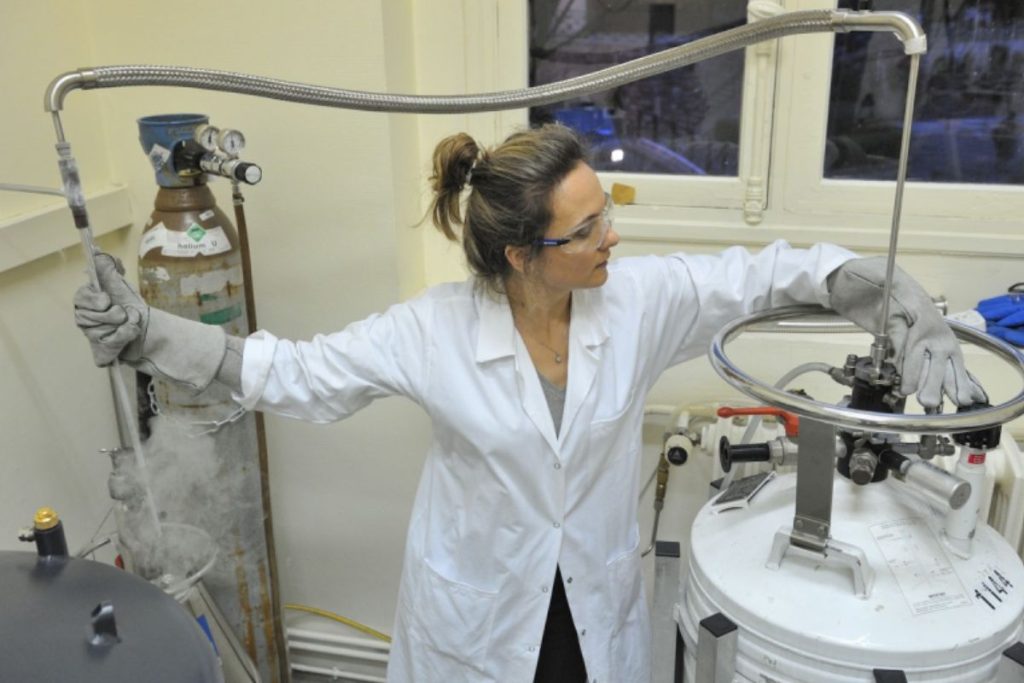
Image: Insertion of a transfer rod into a cryostat to transfer liquid helium © Benoît RAJAU/CNRS Images