A quiet revolution in a flask.
Some scientific breakthroughs arrive with fanfare. This one began with a plastic bag in a beaker.
At a lab in Singapore, a team of chemists stared down one of the modern world’s most persistent enemies: polyethylene, the ultra-stable plastic that wraps our groceries, clogs our oceans, and refuses—politely but firmly—to decompose.
Then they did something remarkable. Using a powdered catalyst made from vanadium, a relatively humble metal, and a little simulated sunlight, they cracked the plastic open. Not burned it, not melted it—they rearranged it, molecule by molecule, into something useful: formic acid, a clean, compact fuel.
You can also read:
A slow, elegant unzipping
Plastic is stubborn by design. Its backbone is a chain of carbon atoms—strong, tight, nearly unbreakable. Industrial chemists have long accepted that turning polyethylene into anything else means high temperatures, toxic chemicals, and a lot of energy.
But the scientists at Nanyang Technological University (NTU) took a different route. Instead of attacking the plastic head-on, they designed a vanadium-based photocatalyst that hooks onto weak points in the plastic’s structure, then uses solar energy to unzip it slowly—gracefully, even.
It doesn’t explode. It doesn’t sizzle. The plastic just… dissolves. And after a few days in sunlight, what’s left is formic acid, a liquid with a future: it’s used in hydrogen fuel cells, preservatives, and power generation.
Italy’s tiny space rice could feed astronauts—and maybe the rest of us
No platinum, no palladium, no problem
The trick here isn’t just in what the catalyst does—but in what it isn’t.
Unlike many industrial catalysts that rely on platinum, ruthenium, or even cadmium—rare, expensive, and often toxic metals—the NTU team’s catalyst is based on vanadium, the kind of metal you’d find strengthening steel in a car door.
It’s cheap. It’s available. It doesn’t poison the groundwater. And it works.
Which makes the process scalable in ways that other plastic-recycling technologies aren’t.
A plastic life cycle with a happy ending
In Singapore, most plastic waste ends up in incinerators. The ashes go to Semakau Landfill—a manmade island that will be full by 2035. That’s the timeline.
Now imagine a different loop: the same plastic that once wrapped your takeout lunch gets broken down with sunlight, turned into fuel, and powers a hydrogen bus downtown. The emissions? Almost nothing. The leftovers? Useful.
What this lab has done is sketch out a path to a circular plastic economy. Not a hypothetical. A demonstration.
Four ways to deal with plastic waste
| Method | What It Uses | What It Produces | Risks & Downsides |
|---|---|---|---|
| Incineration | Heat | Energy + CO₂ + ash | High emissions, landfill overflow |
| Photoreforming | Sunlight + water | Hydrogen gas | Often uses toxic cadmium |
| Chemical recycling | Strong solvents | Base monomers | Energy-intensive, expensive |
| NTU Photocatalysis | Sunlight + vanadium | Formic acid | Slow for now, but safe and scalable |
The lab, the light, and the long game
To be clear: this isn’t a backyard project. The plastic still needs to be heated—about 185°F (85°C)—to dissolve in a solvent. The vanadium catalyst (still a powder) then works its way into the mix. Under artificial sunlight, the reaction begins.
It’s slow. Over six days, the catalyst untangles the plastic chains like a patient librarian sorting a pile of tangled audio cassettes.
And it doesn’t stop there. The researchers tested the same method on 30 different compounds, and in nearly every case, it worked.
A small beam of hope
There’s still work to do. The process happens in a flask, not a factory. The team wants to push it further—to generate not just formic acid, but hydrogen gas, or even other base fuels.
But already, the implications are big: this is plastic turned useful again, not in 500 years, but in under a week. And all it asks for is sunlight, vanadium, and time.
Maybe that’s how change happens. Not with a bang, but with a quiet beam of light through a lab window, falling on something we were ready to throw away.
And suddenly, it becomes fuel.
Source:
“Visible Light–Driven Cascade Carbon–Carbon Bond Scission for Organic Transformations and Plastics Recycling” by Sarifuddin Gazi, Miloš Ðokic, Kek Foo Chin, Pei Rou Ng and Han Sen Soo, 24 October 2019, Advanced Science.
DOI: 10.1002/advs.201902020
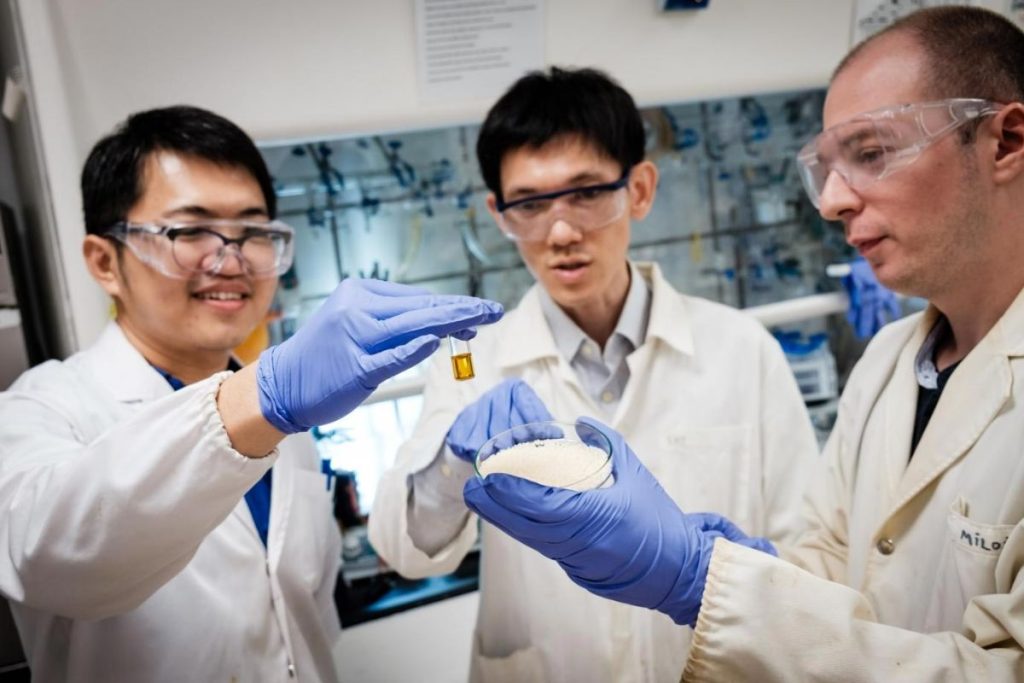
Credit image: (From left) Research fellow Dr Chin Kek Foo, NTU Asst Prof Soo Han Sen and Dr Milos Dokic discussing their new photocatalyst – NTU Singapore