
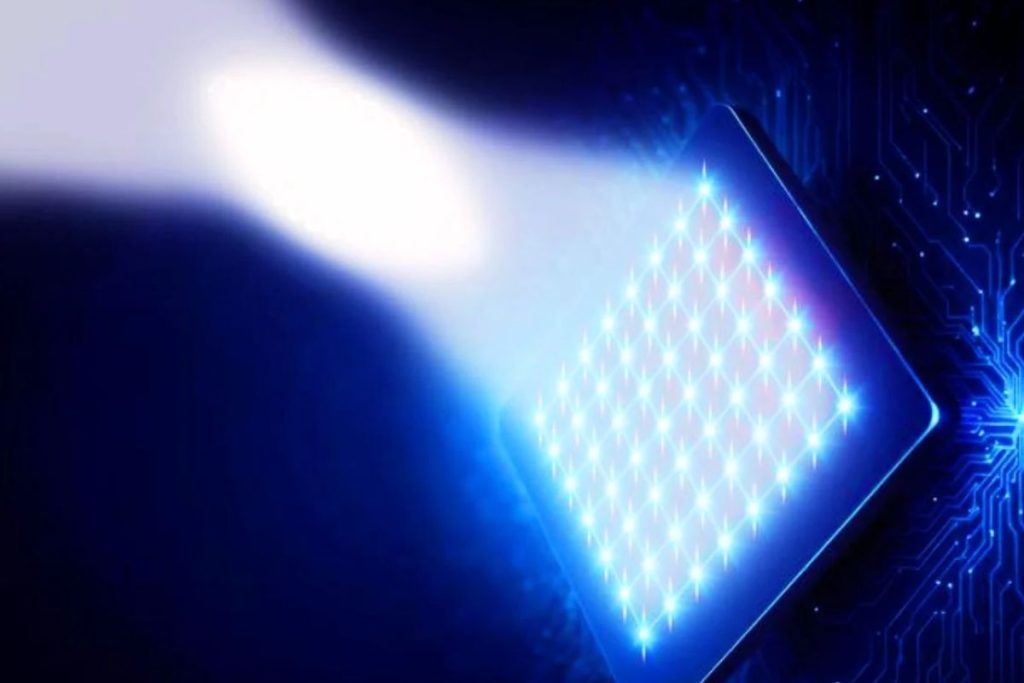
The art of catching a ghost made of light.
Lasers of this scale don’t behave. They don’t wait. When a petawatt laser fires—releasing over one quadrillion watts of power in a flash—it moves faster than thought and vanishes even quicker. Think 30 femtoseconds. That’s 0.00000000000003 seconds. Until now, getting a clear picture of such a pulse was like trying to photograph a lightning bolt by blinking.
Enter RAVEN. Not the bird, but an ingenious piece of optical technology that just pulled off a feat once thought impossible: capturing, in a single shot, the full 3D profile of one of the world’s most powerful lasers—live, and in real time.
You can also read:
- Better late than never: a forgotten 1938 experiment just reshaped nuclear fusion research
- Finland approves a nuclear reactor that doesn’t make electricity—and that might be the point
What makes these lasers so untouchable
Petawatt lasers belong to a strange corner of physics, where energy behaves more like geometry than firepower. These pulses are used to simulate stellar interiors, ignite fusion reactions, or probe the outer limits of quantum electrodynamics. A single pulse from one of these systems, like France’s Apollon (10 PW) or America’s new ZEUS (2 PW), can accelerate electrons to near-light speed within a sliver of space.
Here’s a quick sampling of the usual suspects:
| Laser Name | Country | Max Power (PW) | Application Highlights |
| Apollon | France | 10 | Ultra-short pulse, high-energy physics |
| Atlas-3000 | United States | 3 | Military-grade, experimental science |
| ZEUS | United States | 2 | Electron acceleration in plasma |
| Pétal | France | 1.2 | Coupled to Megajoule laser for inertial fusion |
| SLAC Laser | United States | 1 | Quantum physics, light-matter interactions |
| Vulcan | United Kingdom | ~1 | Plasma research, industrial applications |
Capturing these pulses with any fidelity has, until now, meant hundreds of repeated shots, manually reassembled like a shattered vase. The result? Blurry, incomplete, and often outdated images. That’s a problem when you’re dealing with experiments where a micrometer of misalignment can ruin the day.
The machine that wants to swallow a star: Westinghouse joins ITER’s deep end
How RAVEN does what no one else could
The new technique—Real-time Acquisition of Vectorial Electromagnetic Near-fields—relies on a counterintuitive insight: the more extreme a laser pulse, the more tightly it’s confined in both space and time. Which means you don’t need a massive optical cathedral to analyze it. Just a smart one.
Here’s how it works:
- The incoming laser beam is split into two.
- One half passes through a crystal that sorts the beam’s polarizations—think of it as filtering the beam’s “twist.”
- The other analyzes how color (wavelength) shifts over time.
- Then, a grid of microlenses breaks the beam’s wavefront into tiny parcels—like turning a thunderclap into a sheet of musical notation.
- A camera snaps everything in one go. No scanning. No waiting.
- The data is fed to a neural network that reconstructs a full 3D vector field of the laser’s electric and magnetic structure.
It’s not just a photograph. It’s a portrait of the beam’s anatomy, captured faster than the blink of a neuron.
Why the test run stunned even the researchers
The first demonstration was performed using ATLAS-3000, a 3-petawatt laser in the United States. And the images they got? Revealing in a way no previous method had managed.
For the first time, scientists observed subtle distortions known as spatiotemporal couplings—where the laser’s shape in space affects its evolution in time. These distortions, although almost invisible, can drastically impact fusion performance or particle acceleration accuracy.
And here’s the kicker: RAVEN does this in milliseconds, right as the laser fires. Which means adjustments can be made on the fly, something that could cut hours of calibration down to mere seconds.
Fusion, photons, and the next frontier
One of the biggest applications? Laser-driven nuclear fusion.
In setups like inertial confinement fusion (ICF), dozens of lasers converge on a tiny pellet of hydrogen, compressing it to solar-core conditions. Any delay, misfocus, or misalignment in one beam ruins the whole shot.
With RAVEN, each pulse can now be measured and optimized in real time. It’s like tuning a symphony not after the performance, but as it plays.
This opens the door to even more speculative experiments: for instance, colliding two petawatt pulses in a vacuum, hoping to observe vacuum birefringence, a predicted effect in which light modifies light—something quantum physics says should happen, but no one’s seen.
What makes this so beautifully simple
Perhaps the most surprising part of this story is how elegant the solution turned out to be. The lead researchers didn’t need exotic quantum sensors or kilometer-long setups. The core components—microlens arrays, polarizers, and smart detectors—are compact, even portable.
Dr. Andreas Döpp, one of the study’s senior authors, summed it up neatly: “The key was realizing that the beam itself limits the problem’s complexity. The pulse is so tightly packed in space and time, you don’t need a complicated system to decode it.”
That realization turned out to be the gateway. The RAVEN concept took shape when Sunny Howard, a doctoral student from Oxford, spent a research visit in Munich. A few months and some clever optics later, the team had built a device that can map the inner contours of a beam more intense than a lightning strike—down to the micrometer.
The impact is already spreading
Beyond fusion and fundamental physics, RAVEN could boost every field that relies on ultra-intense light:
- Plasma physics: Cleaner, more stable pulses
- Particle accelerators: Sharper beam shaping
- Quantum optics: Direct testing of extreme field theories
- High-energy imaging: Better snapshots of fast-moving phenomena
The Oxford–Munich–Max Planck team is now planning trials with even more powerful systems. They’re looking at multi-beam arrangements, where laser pulses cross and overlap—something that was impossible to monitor with traditional tools.
Dr. Peter Norreys, co-author of the study, puts it plainly: “Where older methods take hundreds of tries, RAVEN needs just one. And that one shot tells you everything.”
Source:
Howard, S., Esslinger, J., Weiße, N., Schröder, J., Eberle, C., Wang, R. H. W., Karsch, S., Norreys, P., & Döpp, A. (2025). Single-shot spatiotemporal vector field measurements of petawatt laser pulses. Nature Photonics. DOI: 10.1038/s41566-025-01698-x
Illustration credit: Nate Blackthorn