A metal tube that heats like a star.
It doesn’t look like much—just a hollow tube, really. But the TH1507U, built by French aerospace and defense company Thales, has just redefined what it means to generate heat from electromagnetic waves. Its name sounds like a bar code, yet this instrument is setting the tone for the next generation of nuclear fusion technology.
On June 27, 2025, Thales announced that this gyrotron achieved a world-record power output of 1.3 megawatts sustained over 180 seconds, operating at a frequency of 140 gigahertz. That’s enough continuous energy to light 13,000 100-watt bulbs—or more specifically, to heat superhot plasma inside the world’s largest stellarator, the Wendelstein 7-X, in Greifswald, Germany.
A reminder: plasma is no ordinary gas. To make it, you need to bring matter to temperatures ten times hotter than the Sun’s core. You cannot touch it. You cannot contain it with materials. So, you heat it remotely—with radio waves. That’s where the gyrotron earns its keep.
You can also read:
- America ships a 60-foot magnetic giant to France: the unseen backbone of the ITER fusion reactor
- Forget ITER—France may have just found its most realistic nuclear path in a 200 MW box
How to boil a star without melting your lab
Heating plasma is like herding bees with a flashlight: chaotic, delicate, and immensely hot. The TH1507U does this by firing an ultra-precise electromagnetic wave into the reactor’s magnetic containment chamber. No contact. No flame. Just pure resonant energy shaking electrons into an ecstatic frenzy.
The trick? The frequency has to be exactly tuned to interact with the plasma. The beam must stay stable, the power must be continuous, and the entire device must survive harsh electromagnetic backlash. In short: engineering nightmare. And yet, Thales’ gyrotron just made it look routine.
Even better: it did this not in a tokamak—the more familiar donut-shaped reactor—but in a stellarator, a rarer and more convoluted cousin.
Finland approves a nuclear reactor that doesn’t make electricity—and that might be the point
Inside the Wendelstein 7-X: Where fusion physics twists
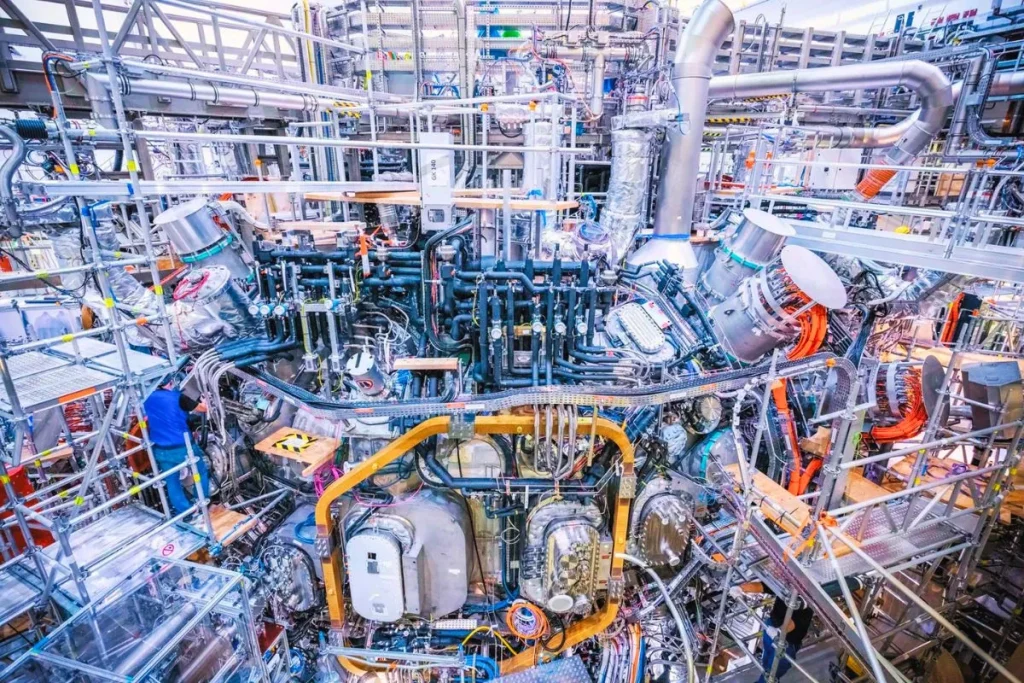
At first glance, the Wendelstein 7-X doesn’t look like any reactor you’ve seen. No ring of glowing plasma. No symmetrical torus. Instead, it resembles a frozen Möbius strip, crisscrossed with magnets.
That weird shape is no accident. Unlike tokamaks, which require pulsed electric currents to stabilize plasma, stellarators rely only on their magnetic coils. Their twisted geometry allows for continuous plasma confinement—a dream condition if we ever want to produce fusion electricity on a grid.
Since 2015, Wendelstein 7-X has been a laboratory for advanced plasma studies. In 2024, it entered a new experimental campaign. The Thales gyrotron record landed right in the middle of it.
Here’s how the two designs compare:
| Criterion | Stellarator | Tokamak |
|---|---|---|
| Plasma confinement | Twisted magnetic fields only | Magnetic coils + current in plasma |
| Stability | High, stable by design | Needs periodic control pulses |
| Operational duration | Continuous possible | Pulsed operation |
| Design complexity | Extremely complex | Relatively straightforward |
| Key examples | Wendelstein 7-X (Germany) | ITER (France), EAST (China) |
| Readiness | Advanced experimental | Closer to net energy goals |
Thales enters the rarefied club of extreme heating
The TH1507U is not some off-the-shelf gizmo. It’s a custom-built instrument, designed in collaboration with the European Gyrotron Consortium (EGYC). Operating at 140 GHz, it’s tailored for plasma reactors but flexible enough to adapt to different setups.
Currently, Thales is the only European manufacturer producing these high-power gyrotrons, putting it in a rare technological bracket. The gyrotron, in this context, is akin to a jet engine for plasma: a machine that doesn’t move air but pushes charged particles to the brink of thermonuclear conditions.
If fusion ever becomes commercial, such gyrotrons will be as essential as turbines are today for steam power.
Why this matters (and why it’s not enough yet)
Let’s not get ahead of ourselves. Running a gyrotron for three minutes is not the same as running a power plant for three years. Fusion still faces numerous roadblocks.
Among them:
- Maintaining plasma stability for hours
- Mass-producing rare fuels like tritium
- Scaling up magnet systems and confinement chambers
- Reducing the infrastructure costs, which currently run into billions of dollars
But it’s clear that the building blocks are lining up. We now know how to:
- Heat plasma efficiently
- Confine it without touching
- Simulate and model it with quantum accuracy
All that remains is to assemble these feats into a reactor that can output more energy than it consumes—consistently and affordably.
Europe still has a seat at the fusion table
While private ventures in the U.S., China, and the UK grab headlines with compact tokamaks and laser-pulsed capsules, Europe is quietly stacking achievements in gyrotron mastery, plasma diagnostics, and stellarator research.
Thales, the Max Planck Institute, and other partners are placing bets on complementary fusion paths. If successful, their contributions won’t just heat plasma—they’ll heat cities.
And when the lights turn on, this obscure, humming, high-frequency tube—the TH1507U—might be remembered not for its name, but for the future it helped ignite.
Source: Thales
Image: the Wendelstein 7-X (Max Planck Institutes and Experts)