A black iceberg appears off Labrador: what science says when the surreal becomes real.
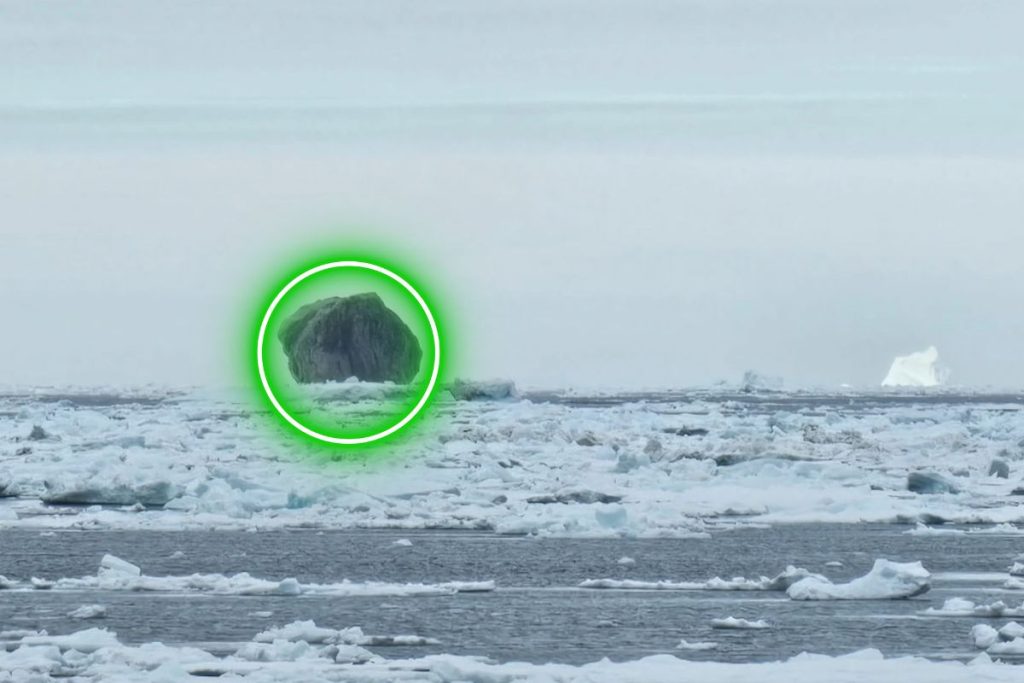
It rose from the sea like something not meant to be seen. A dark monolith, faceted like obsidian, floating in the frigid waters off Canada’s northeastern coast. Not the bright white bergs we know, but something other. A fisherman named Hallur Antoniussen, out of the Faroe Islands, spotted the mass near Hopedale Channel, Labrador Sea. His reaction wasn’t theatrical. It was seasoned awe.
“I’ve been on the water for 50 years. Never seen anything like it,” he said.
Antoniussen’s vessel, Saputi, was navigating iceberg-infested waters. But this one wasn’t just ice. It was jet-black, symmetrical, smooth as if hand-carved. About three times the size of a standard bungalow, he said. Photos he snapped were uploaded within hours. The internet, predictably, did what it does: screamed hoax, alien, art installation. But glaciologists blinked, squinted… and started talking.
You can also read:
Why black?
Color in ice is rarely random. White comes from trapped air scattering light. Blue, from dense, air-free layers that absorb red wavelengths. Black? That’s more complex.
There are three main theories.
- Sediment-rich glacial ice.
According to Dr. Lev Tarasov, a climatologist and glaciologist based in Newfoundland, the berg could have been formed from deep layers of glacial ice saturated with finely ground rock. Think of it as geological cake batter: a blend of compressed snow, pressure, time, and pulverized bedrock. Over thousands—maybe even hundreds of thousands—of years, this material accumulates as glaciers grind over terrain.
If the ice comes from the base of a glacier, where rock and dust are embedded under extreme compression, the light absorption increases dramatically. The result: ice that looks almost black. Not dirty on the surface. Uniformly dark.
- Volcanic ash or soot.
It’s possible the dark layers include airborne debris—volcanic ash from a long-past eruption, or soot from forest fires. These particles could have settled on glacier surfaces and been compressed into the ice as more snow accumulated. This wouldn’t make the entire iceberg black unless these events were sustained over long periods. But partial blackening is common in glaciers close to active volcanoes. - Meteorite dust.
Here, we enter speculative territory. The Hiawatha impact structure, buried beneath Greenland’s ice sheet, may have ejected dark material into the atmosphere thousands of years ago. If those particles settled onto an ice field that eventually calved into the sea, it could explain the composition. It’s unlikely—but not impossible. Without sampling, it’s guesswork.
The physics of darkness
Dark ice isn’t just about looks. It acts differently.
The dense, low-bubble composition absorbs more solar radiation. That means it melts faster than standard icebergs. But it’s also stronger and more resilient to wave action. That might explain the almost geometric shape: minimal erosion, minimal cracking. Think of it like tempered glass drifting through a saltwater bath.
Glacial ice that forms at depth undergoes continuous pressure from overlying layers. This squeezes out air, reduces scattering, and amplifies optical density. Black ice isn’t opaque—it’s optically clean.
What makes this iceberg unique, according to marine researchers in St. John’s, is the combination of features: the sheer mass, the symmetrical profile, the near-total absence of erosion marks, and the absolute blackness.
Tracking a traveler
The Iceberg Alley off the coast of Newfoundland and Labrador is a known corridor. Each spring and summer, hundreds of icebergs calve from Greenland and Arctic Canada, drifting southward with the Labrador Current. Most are irregular, fractured, visibly worn. Not this one.
Its edges were smooth, like it had barely touched another surface. No clear scarring, no roll marks. That suggests either a very recent break-off—or an internal structure much tougher than average.
Where exactly it came from is unknown. A few hundred miles north? The east coast of Greenland? The only way to know would be ice-core sampling and isotopic analysis. Until then, it’s a puzzle.
Signal or fluke?
There’s a whisper of climate change in this story. And not just because the sight was unsettling. Icebergs of this density and coloration tend to come from deep within glaciers. Their release may mean that old ice layers are reaching the ocean more frequently. If true, that implies glaciers are thinning faster than expected—or calving deeper than usual.
There’s no smoking gun. But researchers are watching.
If such bergs become more common, they’ll alter the optics of polar ice surveys, impact marine navigation (they’re harder to detect on radar), and increase meltwater input into the North Atlantic.
As Dr. Tarasov puts it: “One black iceberg doesn’t rewrite the textbook. But it sharpens the pencil.”
A frozen time capsule
In essence, the black iceberg drifting near Carbonear isn’t just a visual oddity. It’s compressed time. A fragment of a glacier that remembers volcanic winters, Arctic winds, and dust storms from thousands of years past.
You don’t need to believe in omens to feel something when staring at it. Something that large and dark, floating silently—quiet history on the move.
Reference:
- https://www.cbc.ca/news/canada/newfoundland-labrador/black-iceberg-labrador-coast-1.7551078
- https://www.theweathernetwork.com/en/news/nature/outdoors/rare-black-iceberg-spotted-off-labrador-coast-has-social-media-buzzing
Picture: Photo of the black iceberg (Credit: Hallur Antoniussen)