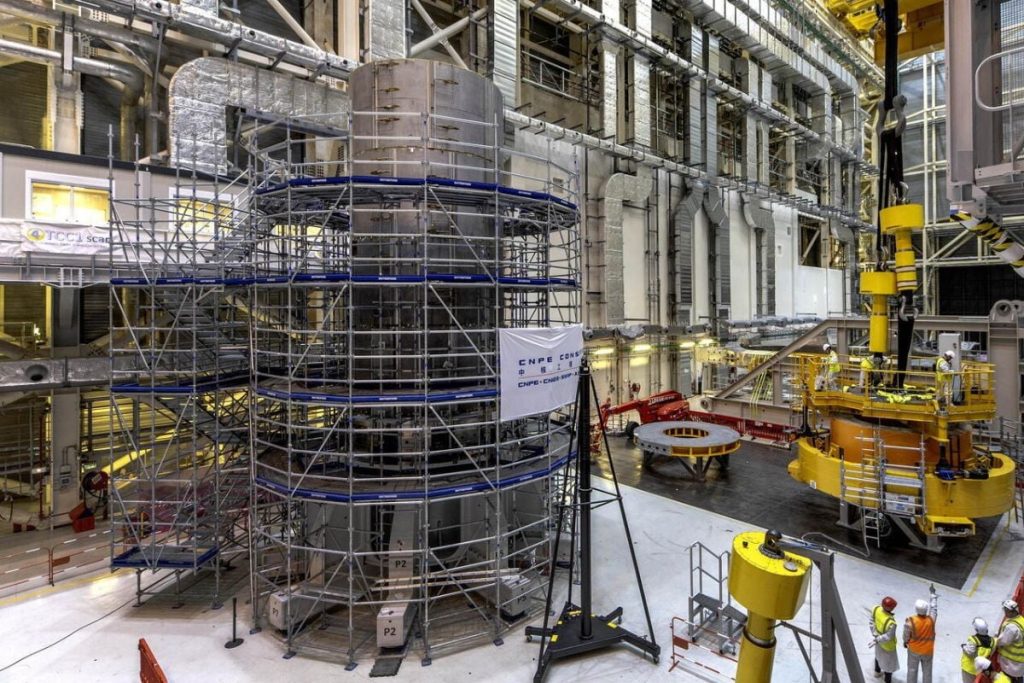
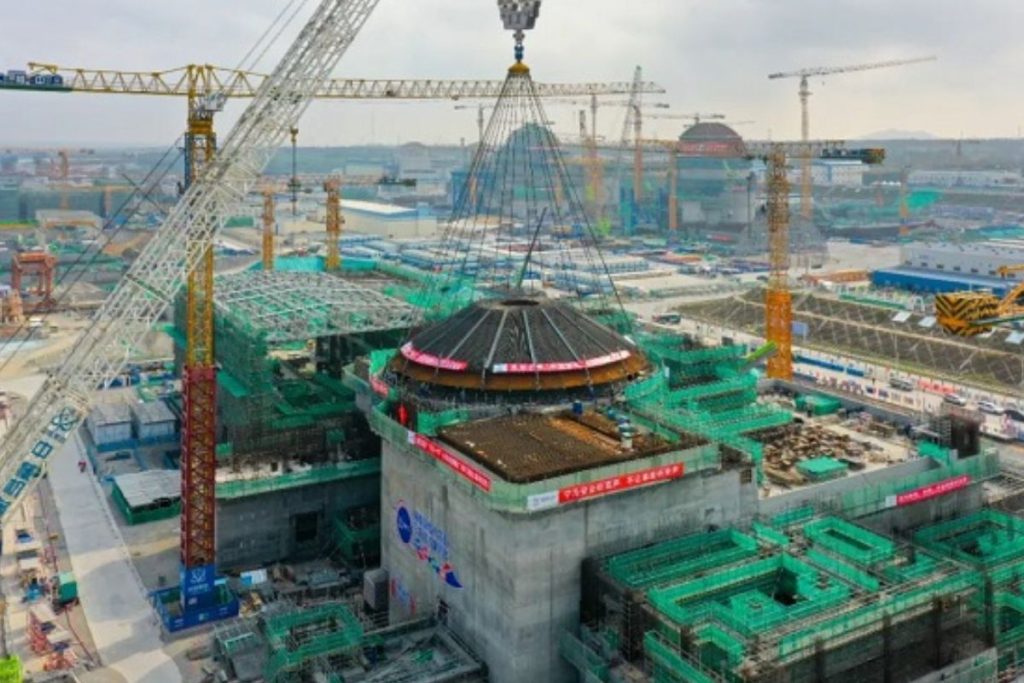
Picture a squat concrete cube tucked into the landscape, no bigger than a convenience store, yet powerful enough to supply electricity to over half a million households.
That’s exactly what China is about to activate on the island of Hainan. The unit is called Linglong-1, the world’s first commercial small modular reactor (SMR)—unless you count Russia’s floating Akademik Lomonosov, which is more nuclear barge than power plant.
Rated at 125 megawatts electric, Linglong-1 is designed to deliver 1 billion kilowatt-hours per year. It’s small, but serious. And it plants a very visible flag in the race for nuclear miniaturization—a race the West hasn’t won.
You can also read:
Linglong-1: a power block the size of a grocery store and safety without the red button
Nuclear always triggers anxiety. But the new generation of SMRs is different. Take Linglong-1: it features passive safety systems, meaning that if anything goes wrong, the reactor shuts itself down without needing any human intervention.
This kind of system is not just smaller—it’s smarter. It adapts to places where traditional reactors don’t fit: industrial sites, mines, off-grid regions. Linglong-1 is a power plant that can move closer to where the demand actually is.
And it’s not an accident. This reactor fits squarely into China’s 14th Five-Year Plan (2021–2025), which emphasizes clean energy and innovation. Approved by the International Atomic Energy Agency in 2016, the design is now undergoing final system checks. Think of it as a dress rehearsal: engineers are simulating operations using cold water, before letting steam flow for real.
A small reactor with big climate gains
Once online, Linglong-1 could offset up to 880,000 metric tons of CO₂ emissions per year. That’s the equivalent of planting 7.5 million trees—and then doing it again, every single year. For China, it’s both a decarbonization strategy and a soft power play: showing the world that homegrown nuclear tech is not just viable, but export-ready.
The symbolism matters. The country that once relied heavily on imported designs is now building its own low-carbon future, one reactor at a time.
Following the trail blazed by Hualong One
Before Linglong-1 came Hualong One, China’s flagship large-scale reactor now operating at full capacity. Linglong is its little sibling: compact, modular, installable in remote or space-limited locations, yet delivering high reliability.
This makes it especially attractive to countries with tight budgets, limited space, or political resistance to megaprojects. For these nations, mini-reactors might be a perfect compromise: less intrusive, less expensive, and much faster to deploy.
Beyond borders: the export ambition
China is not shy about its plans. It wants to sell Linglong-1 abroad, especially to countries still tied to coal but unable to invest in full-size nuclear facilities. The idea: give them a plug-and-play reactor that can operate in extreme environments without a massive grid overhaul.
Now the challenge is persuasion—convincing buyers that these pocket-sized reactors are reliable, affordable, and safe. If Hainan’s demo succeeds, it might just unlock a global wave of mini-nuclear builds.
how does Linglong-1 compare to other SMRs?
Here’s how it stacks up in the global landscape of modular nuclear tech:
| Country / Region | Project / Technology | Power (MW) | Status / Target Date | Notes |
|---|---|---|---|---|
| Russia | Akademik Lomonosov (floating barge) | 35 | Operational since 2019 | First SMR in service, Arctic deployment |
| China | HTR-PM (high-temperature gas-cooled) | 210 (2×10⁵) | Grid-connected in 2023 | Pilot molten salt reactor prototype |
| USA | TerraPower Natrium | 345 | Under construction, ~2030 | Backed by Bill Gates, sodium-cooled |
| USA | X-energy Xe-100 | 80–100 | In development, ~2030 | TRISO fuel, high-temperature gas |
| South Korea | SMART | 100 | Prototype planned by 2030 | Compact integrated reactor, offshore potential |
| Canada | Terrestrial Energy IMSR | 190 | In certification phase | Molten salt design, advanced stage |
| France | Nuward (EDF / Framatome) | 170–300 | In development | Pressurized water SMR, Franco-German effort |
| Romania | NuScale Power | 60 | Final investment decision by 2025 | American tech for decarbonization |
| Japan | JSMR | 50–100 | In design phase | Domestic SMR initiative |
| UK | Rolls-Royce SMR | 470 | Prototype by 2030 | Strong government backing |
| Spain | NuScale Power | 60 | Feasibility study | European collaboration |
| France / Italy | Newcleo (fast molten salt reactor) | 30–50 | Prototype by 2030–2032 | Private Franco-Italian venture, recycling-focused |
The message is clear: China is no longer just catching up—it’s now setting the pace in the SMR race. And Linglong-1, for all its modest footprint, might be the first in a global fleet of compact reactors shaping the future of energy.
Credit: https://www.caea.gov.cn/english/n6759361/n6759362/c10087720/content.html
Image: China National Nuclear Corporation ( CNNC)